Most compass instruction rushes to the field: orient the map, walk the bearing, arrive. This guide slows down one step earlier, to the reading itself, because every field error we have ever seen began as a reading error: a dial misread by ten degrees, a needle trusted beside a steel fence, a declination applied backwards. Reading a compass means fluency with its parts, its two languages of points and degrees, and the small set of readings you will perform thousands of times. Master the literacy here, then take it outside with our companion how to use a compass guide, which assumes everything on this page.
Home / Map Skills for Travel and Outdoors
How to Read a Compass: The Dial, the Degrees, and Red in the Shed

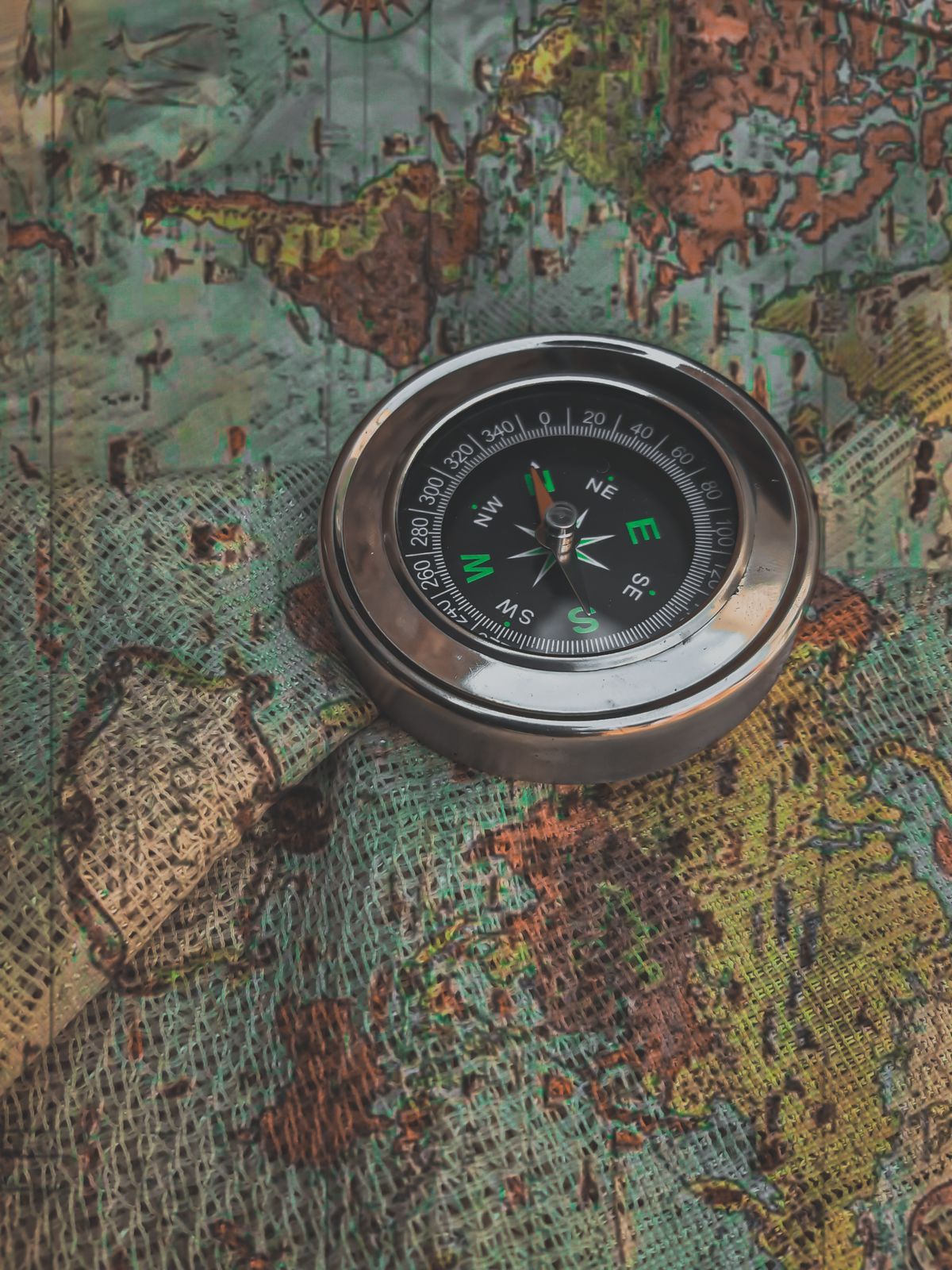
Photo: ArtHouse Studio / Pexels
Interactive map
Distance Measurer: Bearings to Read Aloud
Click two places and read the bearing between them in degrees. Name its compass point from this article table, then convert it with your local declination: subtract east, add west, and say the result aloud the way the drills prescribe.
Total straight-line distance, 0 points
Click the map to start
Distances are great-circle (haversine, mean Earth radius 6,371 km): the shortest path over the surface, not a road or trail distance. Map data © OpenStreetMap contributors.
The Parts, Named Once and Used Forever
A baseplate compass, the transparent kind used with maps, has a vocabulary worth fixing in place:
- Baseplate: the clear rectangle, with rulers along its edges for map measurement.
- Direction of travel arrow: the arrow printed on the baseplate, pointing the way you will walk.
- Rotating housing (the bezel or dial): the ring you turn, graduated in degrees, with N at its top.
- Orienting lines: the parallel lines inside the housing that you align with the map's grid.
- Orienting arrow: the outline arrow at the housing's top, the famous "shed."
- Magnetic needle: the floating needle whose red end points to magnetic north.
- Index line: the fixed mark on the housing's edge where you read the bearing.
Every reading you ever take is some combination of these parts. When instruction anywhere says "put red in the shed," it means rotate yourself or the housing until the needle's red end sits inside the orienting arrow's outline. When it says "read the bearing at the index line," it means the number on the dial that the index line touches is your direction in degrees.
The Dial's Two Languages: Points and Degrees
Compasses speak cardinal points for conversation and degrees for work. The full ring:
| Point | Degrees | Point | Degrees |
|---|---|---|---|
| North | 0 / 360 | South | 180 |
| Northeast | 45 | Southwest | 225 |
| East | 90 | West | 270 |
| Southeast | 135 | Northwest | 315 |
The intercardinal points above sit between the four cardinals, and eight further ordinal points, north northeast and kin at 22.5 degree steps, exist for fine talk but rarely for walking. Degrees are the working language: a bearing of 78 degrees is an instruction; "roughly east northeast" is a mood. Read the dial clockwise from north, always, because azimuths are measured clockwise, the opposite of mathematics class and a fact that trips every beginner once. The measurer above reports bearings between real places in degrees; read a few and name their points to build the translation reflex.
Reading One: What Direction Am I Facing?
Hold the compass flat, level, and still, away from belt buckles, phones, car bodies, and fences, all of which bend the needle's story. Point the direction of travel arrow at the thing you care about: the peak, the trail junction, the far shore. Wait for the needle to settle. Turn the housing until red sits in the shed, needle's red end inside the orienting arrow. Now read the number at the index line. That is the bearing of the thing you face, in degrees magnetic. Flat and still are not fussiness: a tilted compass drags its needle, and a needle still swinging is a rumor, not a reading. Our phone compass calibration guide covers the same physics on the digital side, and compass directions from my location applies facing readings to everyday orientation.
Reading Two: Follow a Number Someone Gave You
Given a bearing, say 240 degrees, the reading reverses. Turn the housing until 240 sits at the index line. Hold the compass flat with the direction of travel arrow pointing away from you. Turn your whole body, compass and all, until red is in the shed. The direction of travel arrow now points along 240 degrees, at whatever the bearing was taken toward. Walk the arrow, picking a landmark on the line to walk to, since eyes wander and arrows do not. The two readings are one skill facing both ways, and fluency is being unable to remember which direction felt harder.
Declination: Translating Between Compass and Map
Your needle points to magnetic north; your map is drawn to true or grid north, and the difference, declination, is printed on every good topographic map's margin with its year. The reading skill is the arithmetic, and the rule for going from a map bearing to a compass bearing is: subtract an east declination, add a west declination. Worked twice, slowly. Your map bearing is 90 degrees and the declination is 12 degrees east: your compass bearing is 90 minus 12, 78 degrees. Same map bearing, declination 8 degrees west: 90 plus 8, 98 degrees. Reverse the operations to convert a compass reading back to the map. Skipping declination entirely is survivable where it is small and ruinous where it is large; at 15 degrees of declination, a one kilometer leg walked uncorrected ends roughly 260 meters off line. The military systemizes this as the G-M angle in our army maps and land navigation guide; the civilian habit is the same arithmetic with a friendlier name.
Reading Errors and the Drills That Kill Them
The classic misreadings are few and curable. Reading the dial's south end of the needle, the white end, gives a bearing 180 degrees wrong; the cure is the red rule, red points north, read red. Reading the number beside the index line instead of under it costs 10 to 20 degrees; the cure is reading aloud. Trusting a needle near metal costs whatever it costs; the cure is stepping away and retaking. The drills: in a park, take bearings to five landmarks and check them against the measurer's bearings between the same places on the map. Set five bearings and follow each for a hundred paces, checking where you arrive. Convert ten map bearings with your home declination until the add and subtract are reflexes. Reading a compass is a morning's literacy and a lifetime's skill, and it is the floor under every other navigation art this site teaches, from reading a topographic map to finding north without a compass when the dial is gone.
The Compass Family: What Changes Between Types
The readings above were taught on a baseplate compass, but you will meet relatives, and their reading quirks differ in small ways worth knowing. A lensatic compass, the military clamshell, is read through a sighting wire and a lens that magnifies the dial; its readings come in degrees and mils together, and it excels at precise bearings to distant objects while offering no transparent base for map work, which is why the army pairs it with a protractor on the sheet. A mirror sighting compass folds a mirror into the lid so you watch the dial and the target in one view; the reading discipline is identical to the baseplate's, with the mirror doing the aligning your eye otherwise shuttles to do. A button or keyring compass tells you roughly which way is north and nothing finer; it is an orientation toy, honest within its limits, and no bearing should ever be read from one for navigation. A phone compass is a magnetometer wearing a dial's clothes; it reads like the real thing but inherits every interference and calibration issue of its hardware, and our phone compass troubleshooting guide covers its failure modes. The literacy transfers across the family because the dial, the needle, and the index line mean the same thing in every member; only the furniture changes.
Keeping the Needle Honest
A compass is an instrument, and instruments drift out of truth in characteristic ways worth a yearly check. A needle can lose magnetism or, worse, reverse polarity after life near strong magnets or speakers, after which it points south with total confidence; the check is a known bearing, a street you know runs east, read against the dial. Bubbles form in the damping fluid of liquid filled compasses at altitude or with age; a small bubble shifts readings little, a large one drags the needle and argues for replacement. The housing's degree ring can slip on cheap compasses after a drop, which the same known bearing check catches. None of this requires a laboratory: one street, one known direction, one reading, once a season, and the instrument's honesty is a verified fact rather than a hope. The readers who do this are the same ones whose bearings land, which is not a coincidence but the definition of an instrument culture: trust, in navigation, is calibration repeated.
Related Guides
The closest companions to this guide are the travel and outdoors map skills guides below. Each one picks up a thread this page starts:
- How to Read a Compass for Kids: The Belly-Button Method and Red Fred in the Shed: Teaching a child to read a compass works when the whole skill is shrunk to two rules a seven-year-old can hold: hold the compass flat at your...
- How to Read a Compass on iPhone: Headings, Locked Bearings, and the Numbers at the Bottom: The Compass app on iPhone is a real magnetic compass with three extras a pocket compass cannot match: a digital heading readout, a bearing lock...
- Compass Directions: The 4, 8, 16, and 32 Points of the Compass Rose, With Degrees: Compass directions are a naming system laid over a circle.
Frequently Asked Questions
What does "red in the shed" mean?
It is the field mnemonic for aligning a compass: turn until the red end of the magnetic needle sits inside the outline of the orienting arrow, the "shed," printed at the top of the rotating housing. With red in the shed, the dial is oriented to magnetic north and the bearing at the index line is true to your direction of travel.
How do I read a bearing off a compass?
Point the direction of travel arrow at your target, hold the compass flat and still until the needle settles, then turn the housing until the needle's red end sits inside the orienting arrow. The number on the dial at the index line is the bearing, measured in degrees clockwise from magnetic north.
What is the difference between a bearing and a back bearing?
A bearing is the direction from you to a target. The back bearing is the return direction, exactly opposite: add 180 degrees to a bearing under 180, subtract 180 from one over 180. A bearing of 78 degrees has a back bearing of 258 degrees. Back bearings walk you home and power the resection technique for finding your position.
How do I apply declination when reading a compass?
To convert a bearing taken from the map into one your compass can follow, subtract an east declination and add a west declination. A map bearing of 90 degrees with 12 degrees east declination becomes a compass bearing of 78 degrees; with 8 degrees west it becomes 98 degrees. Your map's margin diagram states the local declination and its yearly change.
Why does my compass needle point the wrong way indoors or in a car?
The needle answers the strongest local magnetic field, and steel structures, car bodies, speakers, phones, and power lines all outshout the Earth at close range. Readings belong outdoors, at arm's length from metal. A needle that misbehaves everywhere may be demagnetized or reversed, which a compass shop can check against a known bearing.
What are the cardinal and intercardinal points in degrees?
North is 0 or 360 degrees, east 90, south 180, west 270. The intercardinal points sit between them: northeast 45, southeast 135, southwest 225, northwest 315. Bearings in degrees are always measured clockwise from north, which is why east carries a larger number than northeast rather than following the counterclockwise convention of mathematics.
Photo credits: ArtHouse Studio (Pexels); Ishaan Aggarwal (Pexels). Photos are served from this site; follow the credit to the library page for the original.