A compass is the rare survival tool a child can genuinely master in an afternoon, but only if it is taught at child scale. Adult instruction fails kids in predictable ways: too many parts named at once, degrees before direction, and a baseplate held at chest height and twisted at the wrist until the needle means nothing. The kid method strips the instrument to what a young navigator actually uses. A needle that always points north. A red end that has a home to sit in. A body that turns as one piece, compass riding flat at belly-button height. Two rules, three games, and a child who can find north, walk a direction, and follow a bearing across a park while an adult is still unfolding the manual. This guide is written for the adult doing the teaching, at the reading level of the kids, roughly grades 3 to 6, who will do the learning. The companion skill for the same age group lives in our guide to how to read a map for kids; the compass comes first because direction comes before distance.
Home / Map Skills for Travel and Outdoors
How to Read a Compass for Kids: The Belly-Button Method and Red Fred in the Shed
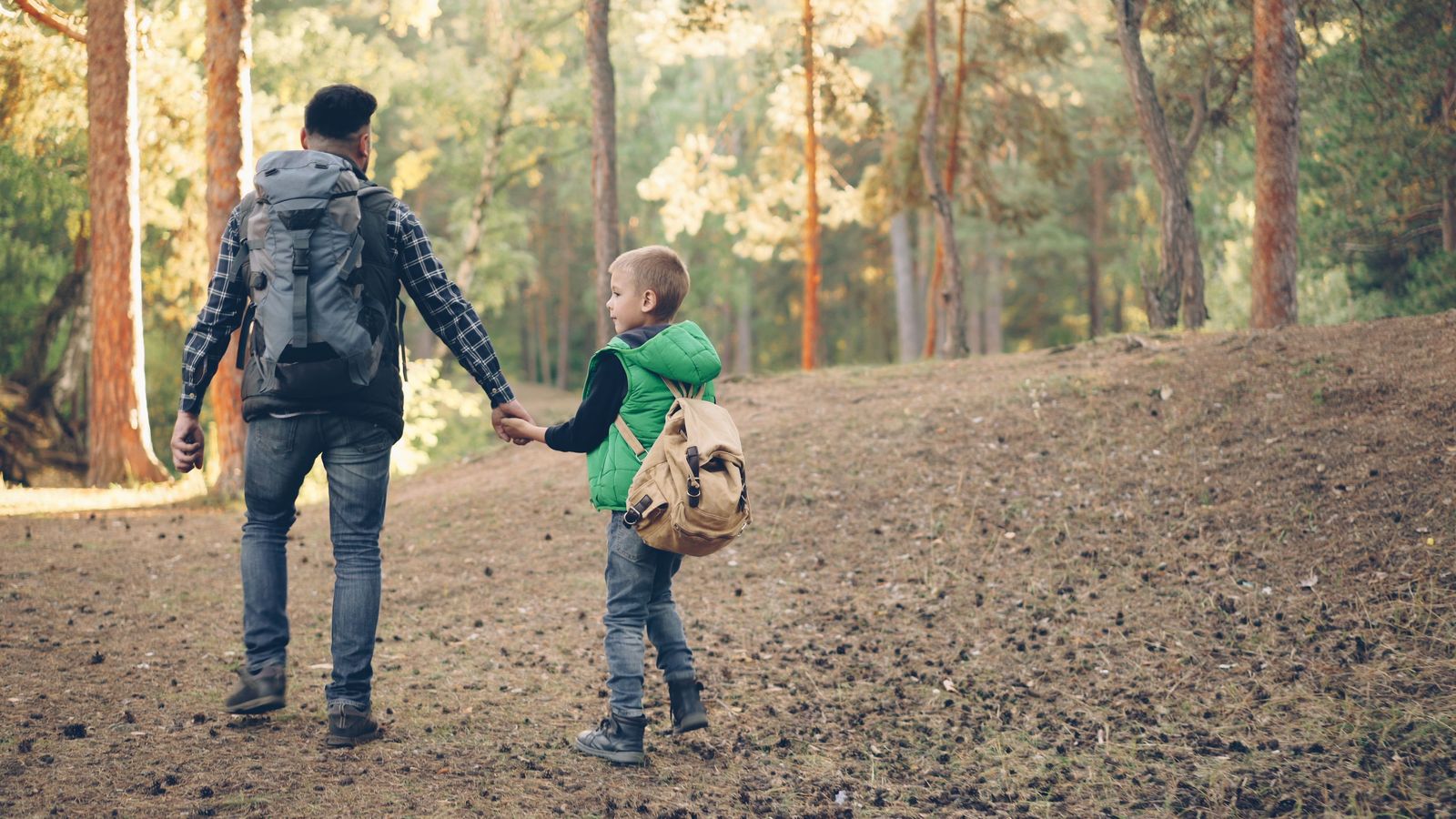
Photo: Vitaly Gariev / Pexels
Teach It Like a Game: The Kids Compass Checklist
Check off each step as you finish it. Your progress stays on this page.
0 of 7 complete
0% done
The Parts, Named Once
Name the parts once, out loud, with the compass in the child's hands, and then never quiz them again; the games will teach the names by use. The needle is the thin arrow that swings freely, and its red end is the famous end, the one that points north. The housing is the round dial the needle lives in, the part that can turn. The baseplate is the clear plastic ruler the housing sits on, and at its front edge is the direction-of-travel arrow, the arrow that points where your feet should go. Inside the housing, printed on its floor, is a red outlined arrow shape, the shed. That is all. Five names: needle, red end, housing, direction-of-travel arrow, shed. Everything in this guide is done with those five, and any term beyond them, degrees, declination, bearings with numbers, belongs to the older-kid sequel, not to this afternoon.
Rule One: Red Fred in the Shed
The needle's red end has a name in the time-honored teaching rhyme: it is Fred. The red outline printed in the housing is his shed. The whole art of using the compass, at this level, is one sentence: turn until red Fred is in the shed. When the child rotates the compass, or better, rotates herself with the compass held still in her hands, the needle swings as the world turns under it, and at exactly one body position the red end of the needle settles inside the red outline of the shed. At that moment the compass and the child are both facing the way the compass is set. Fred in the shed is not a babyish simplification of the real skill; it is the real skill, the same alignment an adult navigator performs, with the jargon stripped off and a rhyme where the jargon used to be. Teach it as a physical delight: the needle is alive, it wiggles, it hunts, and it clicks into its home when you turn to the right place. Kids will do it twenty times for the pleasure of the click. Let them. Those twenty turns are the lesson.
Rule Two: The Belly-Button Method
The second rule governs the body. The compass rides flat, level, at belly-button height, held in both hands against the body, and the child turns her whole body, feet shuffling in a slow circle, until Fred is in the shed. Every word of that is load-bearing. Flat, because a tilted compass drags its needle and lies. Belly-button height, because a compass held up at the eyes gets twisted at the wrist, and a twisted wrist turns the housing instead of the child, which breaks the one thing the method protects: the direction-of-travel arrow must point where the child's nose points, always, because the child walks where her nose points. Whole body, because the skill being built is not "operate a dial," it is "turn yourself until you face the direction," which is the skill that works in a forest with no dial at all. When Fred is in the shed and the arrow points from the child's belly button out into the world, she walks the arrow. That is a bearing, performed correctly, by a second grader.

Game One: The Four Directions From Your Own Door
Stand at your front door, or the trailhead, or the park gate, any threshold the child knows. Set the compass so the direction-of-travel arrow and the shed point to N on the dial, put Fred in the shed with the belly-button turn, and the arrow now points north in the real world. Have the child name what is there: the oak tree is north of our door. Then turn together to E, to S, to W, naming the landmark in each direction. The compass has just become a labeling machine for the child's own geography, and the four cardinal directions have stopped being worksheet words. Repeat at grandparents' houses, at school gates, at campsites. The deep lesson lands quietly: north is not a place on the compass, it is a direction in the world that the needle can always find, and every place the child knows has a north of its own waiting to be named.
Game Two: The Bearing Walk
Now make the compass give an order and the feet obey it. Pick a target across open ground, a lone tree, a goalpost, a picnic table. Let the child point the direction-of-travel arrow at the target, then turn the housing until Fred is in the shed, with the belly-button rule in force throughout: compass flat, body turning, not wrists. The compass is now set to the target's direction. Walk it together, stopping every twenty steps to re-settle Fred in the shed and correct the line, because walking drifts and checking is part of the skill, not a failure of it. Arriving at a tree you aimed at from two hundred meters, using nothing but a needle in a plastic dial, produces a specific and durable pride in a child. Swap roles on the walk back: the child picks the target and sets the compass, the adult walks and gets corrected. Teaching it backwards is mastery arriving early.
Game Three: The Treasure Course
The graduation game hides the targets. An adult walks a short course in advance, three or four legs across a park or a big yard, and writes the course as directions only: from the gate, walk the arrow set to the big rock; from the rock, set to the fence corner; from the corner, set to the bench, where something worth finding waits. The child navigates leg by leg, setting each new bearing by aiming the arrow at each landmark and putting Fred in the shed. Keep the legs short, the landmarks unmissable, and the treasure real, because the game is a delivery device for repetitions: every leg is a full compass set performed for a reason the child cares about. By the third treasure course, most kids are setting bearings without the rhyme said aloud, which is the rhyme's job done. This is also the moment to introduce the one safety truth that matters at this age, in the next section's spirit: the compass tells you direction, never location, and it is a tool for playing and learning with a grown-up nearby, a beginning of navigation rather than a license to wander.
What Ruins a Compass Reading
Kids should learn the compass's enemies as a rogues' gallery, because a needle behaving strangely is a detective story they can solve. Metal is the chief villain: hold the compass near a car, a fence post, a belt buckle, playground equipment, or a phone, and the needle gets pulled toward the metal and away from north. The fix is a step or two of distance and a flat, steady hold. Magnets in toys and tablet cases are the same villain in costume. A tilted compass is the second villain, dragging the needle until it sticks or sulks; flat at the belly button defeats it. And a needle that will not settle at all, wobbling between two answers, is usually reporting a villain nearby rather than a broken compass. Send the child hunting for what is pulling Fred. She is learning the deepest compass lesson there is: the instrument answers its environment honestly, and reading it well means managing the environment, which is why our grown-up guide to how to read a compass spends so much of its length on exactly the same enemies at adult scale.
Related Guides
Readers working through this topic usually need its closest companions too. These travel and outdoors map skills guides cover the neighboring ground:
- How to Use a Compass Bezel on a Watch: The Seiko Method, Both Hemispheres: A compass bezel turns an ordinary analog watch into a sun compass, if you know the setting ritual: point the hour hand at the sun, put the south...
- How to Read a Map Bearing: Extracting the Number From the Map: A bearing is a promise in one number, and the map bearing is where that number is born.
- How to Read a Map for Orienteering: ISOM Colors, Symbols, and Control Descriptions: An orienteering map is not a small topographic map.
Frequently Asked Questions
What age can a child learn to use a compass?
Most children in grades 3 to 6, roughly ages 8 to 12, can learn the two rules in this guide in one session: hold the compass flat at belly-button height and turn your whole body, and put red Fred in the shed. Younger children can play the direction-naming game with an adult holding the compass. The limiting factor is not the instrument; it is keeping the teaching to two rules and three games instead of a lecture.
What does "red Fred in the shed" mean?
It is the classic teaching rhyme for aligning a compass. The red end of the needle is Fred; the red outlined arrow printed in the compass housing is the shed. You turn, with the compass held flat and still, until the needle's red end sits inside the red outline. At that moment the compass is aligned to north and its direction-of-travel arrow points the way you intend to walk.
Why hold the compass at belly-button height?
Because it keeps the compass flat and locked to the body. Held at belly-button height in both hands, the compass turns when the child turns, so the direction-of-travel arrow always points where the child faces. Held up at eye level, the wrists twist, the housing rotates instead of the child, and the arrow stops agreeing with the feet, which is where young navigators go wrong.
Why is the compass needle pointing the wrong way near the car?
Metal pulls the needle. Cars, fences, belt buckles, phones, and playground equipment all disturb a compass at close range, bending the needle toward themselves. Step a few paces away from anything large and metal, hold the compass flat and steady, and let the needle settle. A needle that misbehaves near metal and behaves in open ground is a healthy compass reporting its surroundings.
Is a compass enough to keep a child safe outdoors?
No, and children should hear that plainly from us. A compass gives direction, not location, and a child with a compass and no adult, no map skills, and no plan is not equipped to navigate alone. Teach it as this guide does, as a real skill learned in games with a grown-up present. Direction is the first layer of navigation, and it is a beginning, not the whole.
Photo credits: Vitaly Gariev (Pexels); Ron Lach (Pexels). Photos are served from this site; follow the credit to the library page for the original.