Every direction ever spoken, "head northeast," "a southwest wind," "the ridge runs west northwest," is a name pinned to a number: a bearing, counted in degrees clockwise from north around a full 360 degree circle. The naming system, the compass rose, was built by halving. Halve the circle and halve it again, and each generation of points has a name, a degree value, and a job. This guide lays out the complete system: the 4 cardinal points, the 4 intercardinal points that join them at 8, the 16 point rose that everyday navigation uses, and the traditional 32 point rose of the mariner, whose "by" points survive in weather reports and sailing language. It closes with the conversion skill in both directions, bearing to name and name to bearing, which is all the system is ever used for. For directions measured from where you stand right now, our compass directions from my location guide covers the live version; this page is the system itself.
Home / Map Skills for Travel and Outdoors
Compass Directions: The 4, 8, 16, and 32 Points of the Compass Rose, With Degrees
Photo: Alex Andrews / Pexels
Distance Measurer: Name the Direction of a Real Leg
Click a start and a destination and read the bearing in degrees. Then name it with the compass points from this article: the New York to Boston leg reads about 52 degrees, which is northeast territory, just past the NE point itself.
Total straight-line distance, 0 points
Click the map to start
Distances are great-circle (haversine, mean Earth radius 6,371 km): the shortest path over the surface, not a road or trail distance. Map data © OpenStreetMap contributors.
The Convention: Degrees Run Clockwise From North
Two facts organize everything. North is zero (and also 360, the same direction at the circle's seam). Degrees increase clockwise: east is a quarter turn clockwise from north, south a half turn, west three quarters. This is the azimuth convention used by compasses, maps, and this site's tools, and it differs from mathematics class, where angles run counterclockwise from east; a bearing of 45 degrees is northeast in the field and would be a different line entirely on a math worksheet. When the tool above reports a bearing, say the New York to Boston leg at about 52.3 degrees, it is speaking this convention, and the naming question becomes: which point of the rose does 52.3 degrees belong to? The tables below answer by proximity: a bearing takes the name of the nearest point, so 52.3 degrees, lying between northeast (45) and east northeast (67.5) but closer to 45, is called northeast in 16 point naming, or northeast by east territory in the 32 point rose. Keep the convention and the nearest point rule and the whole system is mechanical.
The Four Cardinal Points
The cardinals are the skeleton: North, 0 degrees. East, 90 degrees. South, 180 degrees. West, 270 degrees. They are the directions of the Earth's rotation axis and the sun's daily arc, the four every child learns, and the reference frame for everything finer. In abbreviations they are single letters, N, E, S, W, and they anchor the naming grammar of all compound points: every other direction's name is built by combining cardinal names in order, north before south, east before west in the compound's own logic, as the next sections show.
The Four Intercardinal Points: The Eight Point Rose
Halve each quarter and the intercardinal (or ordinal) points appear, each named by its two neighboring cardinals: Northeast, 45 degrees. Southeast, 135 degrees. Southwest, 225 degrees. Northwest, 315 degrees. Together with the cardinals they make the 8 point rose, the resolution of everyday speech: weather vanes, real estate descriptions ("a southwest facing garden"), and wind reports live comfortably at eight points, because 45 degree precision matches how people actually perceive and choose directions. Note the naming order in the southern compounds: southeast and southwest put east and west second, consistently, so the abbreviations read NE, SE, SW, NW, and a direction like "east southeast" is not an intercardinal but a 16 point name, which is the next halving.
The Sixteen Point Rose: Secondary Intercardinals
Halve again, at 22.5 degree steps, and eight secondary intercardinal points fill the gaps, named by the nearest cardinal combined with the nearest intercardinal: North northeast (NNE), 22.5 degrees. East northeast (ENE), 67.5. East southeast (ESE), 112.5. South southeast (SSE), 157.5. South southwest (SSW), 202.5. West southwest (WSW), 247.5. West northwest (WNW), 292.5. North northwest (NNW), 337.5. Read a name like west northwest as an instruction: start at west (270), move toward northwest by one step of 22.5, arriving at 292.5. The 16 point rose is the working resolution of serious land and sea navigation: it is the table this site's own direction tools use internally, fine enough that the error from naming, at most 11.25 degrees, rarely changes a decision, coarse enough that the names stay speakable over a radio. When a bearing must be named in words, in a trip report, a rescue call, a set of directions for a friend, the 16 point name plus the degree figure ("WNW, about 292 degrees") is the professional form: the name for the ear, the number for the map.
The Thirty Two Point Rose: The Mariner's "By" Points
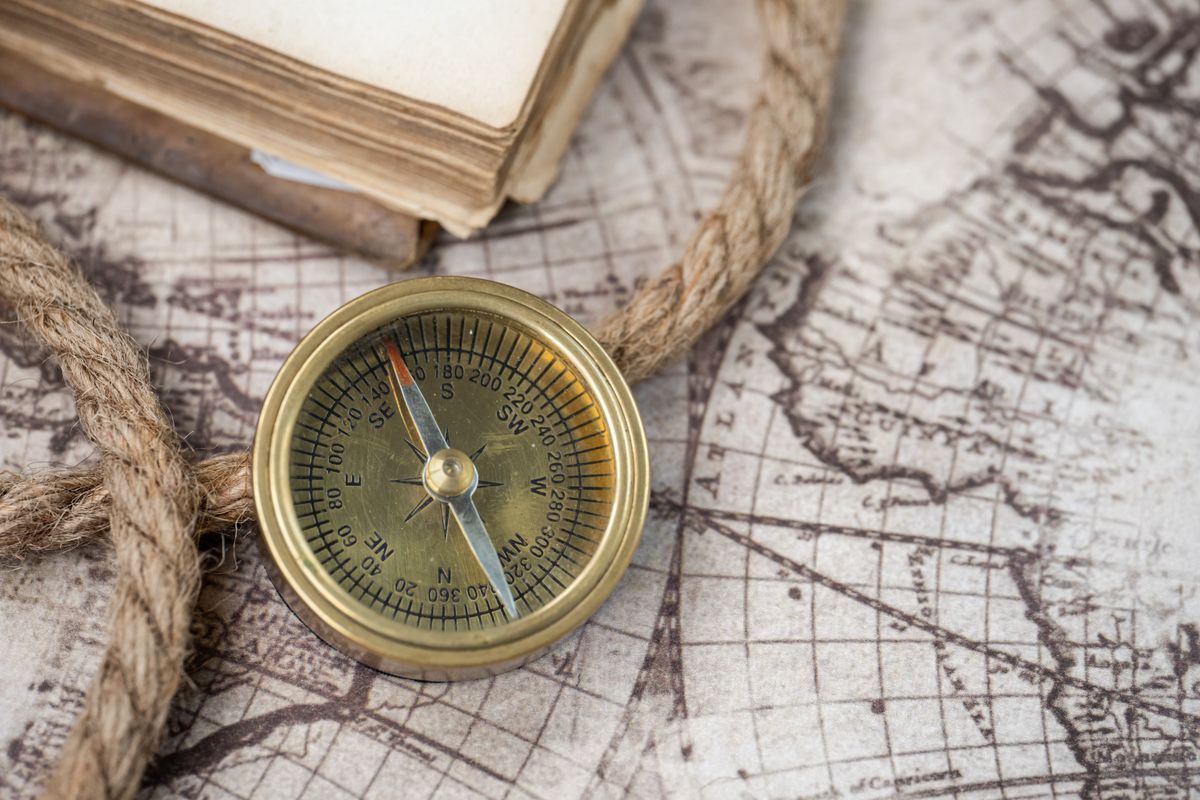
Traditional seamanship halved once more, to 11.25 degree steps, producing 32 points. The new names use the word by: a point is named for its neighbor in the direction of the next cardinal. Around the northeast quadrant the full sequence runs: North (0), North by East (11.25), North Northeast (22.5), Northeast by North (33.75), Northeast (45), Northeast by East (56.25), East Northeast (67.5), East by North (78.75), East (90), and the pattern repeats by symmetry through the other quadrants. "Boxing the compass," reciting all 32 in order, was a rite of seamanship, and the points survive where wind and weather are described traditionally and in the names of the winds themselves. For land navigation 32 points is more resolution than a magnetic compass honestly delivers in the field, which is why the rose's practical heirs stopped at 16 and let degrees carry the rest. Know the "by" names to read older texts and marine forecasts fluently; navigate by 16 and degrees.
Converting: Bearing to Name, Name to Bearing
Bearing to name: divide the bearing by 22.5 and round to the nearest whole number; count that many points clockwise from north on the 16 point list (0 = N, 1 = NNE, 2 = NE, and so on, wrapping past 16 back to north). The New York to Boston bearing of 52.3 degrees: 52.3 divided by 22.5 is about 2.3, rounding to 2, which is NE, matching the nearest point reading from the tables. Name to bearing: reverse it; each point's index times 22.5 is its degree value, which is how the tables above were built. Winds are named backwards, on purpose: a "northeast wind" blows from the northeast toward the southwest, because winds are named for their origin, while a "northeast bearing" is a direction toward the northeast. The two conventions coexist in weather and navigation language, and confusing them reverses a forecast; when a direction describes travel, it is a destination; when it describes wind or current, it is a source. The dial side of all this, reading the degrees off a physical compass, is how to read a compass, and finding the zero of the system with your own needle is how to find north with a compass.
Three Mistakes That Reverse the World
The system is simple enough that its errors form a short, complete list. The math class mix up: importing the convention that angles run counterclockwise from east. On a compass, 90 degrees is east because degrees run clockwise from north; anyone converting bearings for a math or programming context must convert conventions explicitly, since a bearing of 45 and a math angle of 45 are different lines. The wind reversal: reporting a northeast wind as air moving toward the northeast, when the convention names the source; covered above, and repeated here because it is the error professionals still make in logs and forecasts. The naming slip between neighbors: calling west northwest "northwest" in a spoken direction, a 22.5 degree error delivered with total confidence. The defense is the professional form from the conversion section: the 16 point name plus the degree figure, so a slip in the name is caught by the number, and a slip in the number is caught by the name. Two channels, one direction, each checking the other.
The System at Work
Watch the rose do its jobs. A weather forecast says winds southwest at 15 knots veering west: the 8 point rose carrying a source direction and a change. A trail description says the path climbs west northwest from the lake: a 16 point destination direction you can set on a compass as 292.5 degrees. A rescue report gives a bearing of 137 degrees from the lookout: degrees for precision, which the rose names southeast (135) for the radio summary. A sailor's log records the wind at northeast by east: 56.25 degrees of traditional precision. One circle, four resolutions, and the fluency is in choosing the coarsest one that still says what you mean, then adding degrees when money or safety rides on the difference. That judgment, more than the tables, is what it means to know the compass directions.
Related Guides
The closest companions to this guide are the travel and outdoors map skills guides below. Each one picks up a thread this page starts:
- Compass Directions Names: All 32 Points of the Compass, Explained: The compass rose is a naming system with a grammar: 4 cardinal points, 4 ordinal points, 8 half-winds, and 16 quarter-winds make the 32 points,...
- How to Read a Compass Rose: Two Rings, One Variation, and Bearings in Three Figures: The compass rose printed on a nautical chart is not decoration; it is the chart's built-in angle instrument, and it carries two rings for a...
- How to Read a Compass for Kids: The Belly-Button Method and Red Fred in the Shed: Teaching a child to read a compass works when the whole skill is shrunk to two rules a seven-year-old can hold: hold the compass flat at your...
Frequently Asked Questions
What are the 16 compass points in order?
Clockwise from north: North (0 degrees), North Northeast (22.5), Northeast (45), East Northeast (67.5), East (90), East Southeast (112.5), Southeast (135), South Southeast (157.5), South (180), South Southwest (202.5), Southwest (225), West Southwest (247.5), West (270), West Northwest (292.5), Northwest (315), North Northwest (337.5).
How many degrees are between each compass point?
It depends on the rose: 90 degrees between cardinal points (4 points), 45 degrees at 8 points, 22.5 degrees at 16 points, and 11.25 degrees at the traditional 32 points. Each finer rose halves the step of the one before, which is how the system was historically built.
Why is a northeast wind not blowing toward the northeast?
Because winds are named for where they come from, not where they go. A northeast wind blows from the northeast toward the southwest. Bearings for travel are named for the destination. The two conventions are both standard, and the context, wind versus journey, tells you which one is speaking.
What direction is 225 degrees?
Southwest. Bearings count clockwise from north: 180 is south, and 225 is 45 degrees past south toward west, exactly the southwest point. The conversion rule is to divide by 22.5 for the 16 point rose: 225 divided by 22.5 is 10, and the tenth point from north is southwest.
What does "northeast by east" mean?
It is a 32 point rose name: one 11.25 degree step from northeast toward east, which is 56.25 degrees. The "by" points fill the gaps in the 16 point rose and come from traditional seamanship; you will meet them in marine weather language and older navigation texts.
Photo credits: Alex Andrews (Pexels); Ylanite Koppens (Pexels). Photos are served from this site; follow the credit to the library page for the original.