North, south, east, west are the compass as most people meet it, four names for a world of directions. Sailors who steered by compass for a thousand years needed finer language, and they built it into a complete system: 32 named points around the circle, each with a name constructed by rules elegant enough to memorize in an afternoon and use for a lifetime. The system survives because it solves a real problem, giving a helmsman an order he can hear, repeat, and steer to in a storm, "north by east," "south-southwest," with no numbers to mishear. This guide teaches the whole rose: how the points are generated, the full table with degrees, the "by" rule that names the quarter-winds, and the older wind names that still echo in Mediterranean weather reports.
Home / Map Skills for Travel and Outdoors
Compass Directions Names: All 32 Points of the Compass, Explained
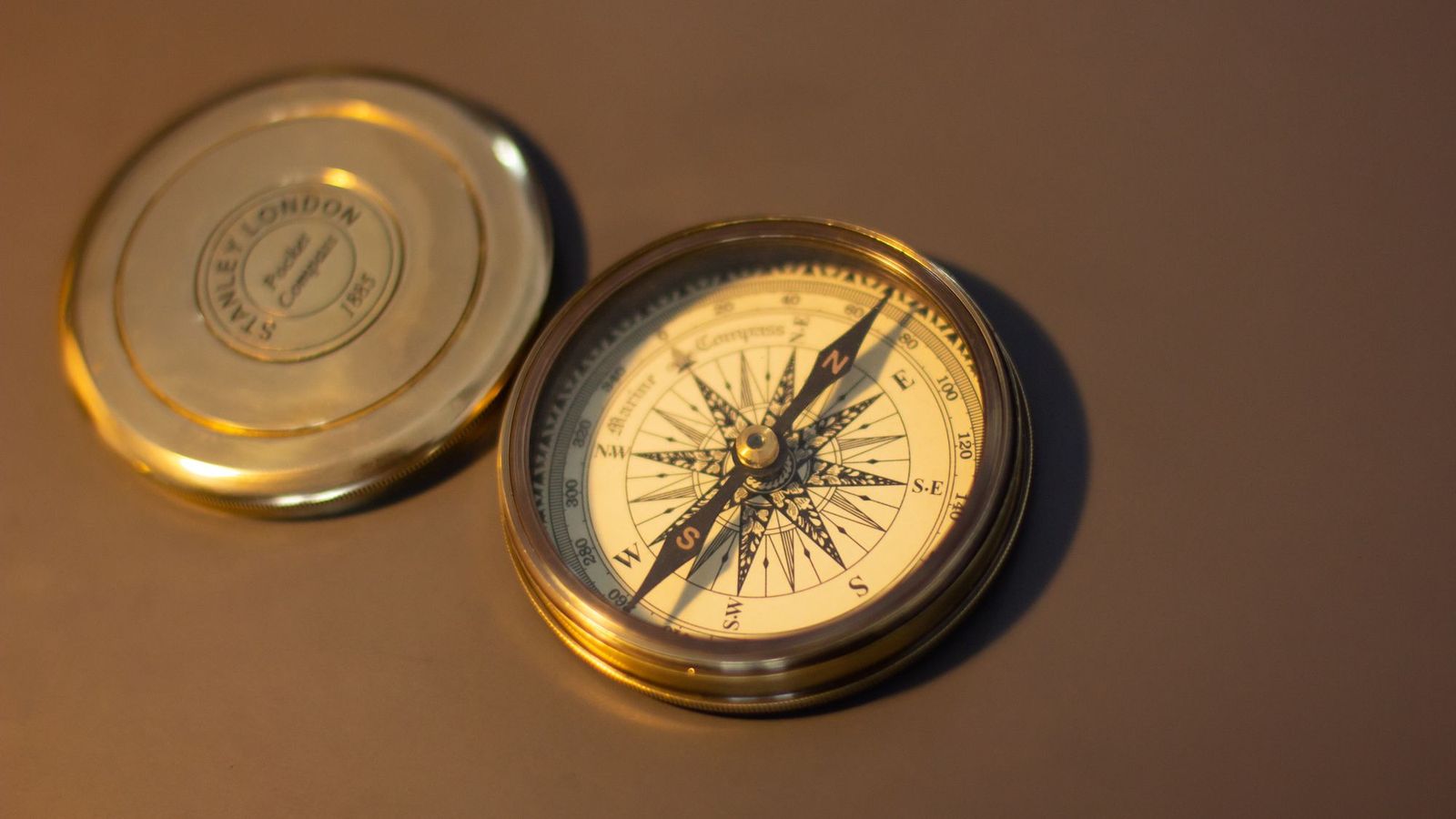
Photo: Jaiju Jacob / Pexels
Learn the 32 Points: The Practice Checklist
Check off each step as you finish it. Your progress stays on this page.
0 of 6 complete
0% done
The Four Cardinals and the Four Ordinals
Start with the skeleton. The four cardinal points are the axes of the world: north (0 degrees), east (90), south (180), and west (270), tied to the Earth's rotation and the sun's daily arc. Between each pair of cardinals sits an ordinal point, named by combining its parents: northeast (45), southeast (135), southwest (225), and northwest (315). Eight points, each 45 degrees from the next, and already enough for most land navigation; a hiker who can name the eight winds can describe any trail direction a companion needs. But 45 degrees is a coarse step at sea, where a ship holds a course for hours and a few degrees of error is a different coastline. So the system subdivides, twice more, and each subdivision has its own naming logic, which is where the system's real beauty lives.
The Half-Winds: Eight Names Built From Their Parents
Bisect each 45-degree gap and you get the eight half-winds, at 22.5-degree spacing from the cardinals. Their names follow one rule: a half-wind is named for the two points it sits between, cardinal-ordinal pairs compressed into three-letter compounds. Between north and northeast lies north-northeast (NNE, 22.5 degrees). Between northeast and east lies east-northeast (ENE, 67.5). The pattern continues around: east-southeast (ESE), south-southeast (SSE), south-southwest (SSW), west-southwest (WSW), west-northwest (WNW), and north-northwest (NNW). Read the name as a tiny sentence: the first element is where you start, the last is the direction you lean. North-northeast is north, leaning northeast. With the half-winds the rose has 16 points, and the spacing is 22.5 degrees, fine enough for most historical sailing and for the wind descriptions in older weather logs and literature, where a "nor'wester" or an "east-northeasterly" blow is doing precise work, not decoration.
The Quarter-Winds and the "By" Rule
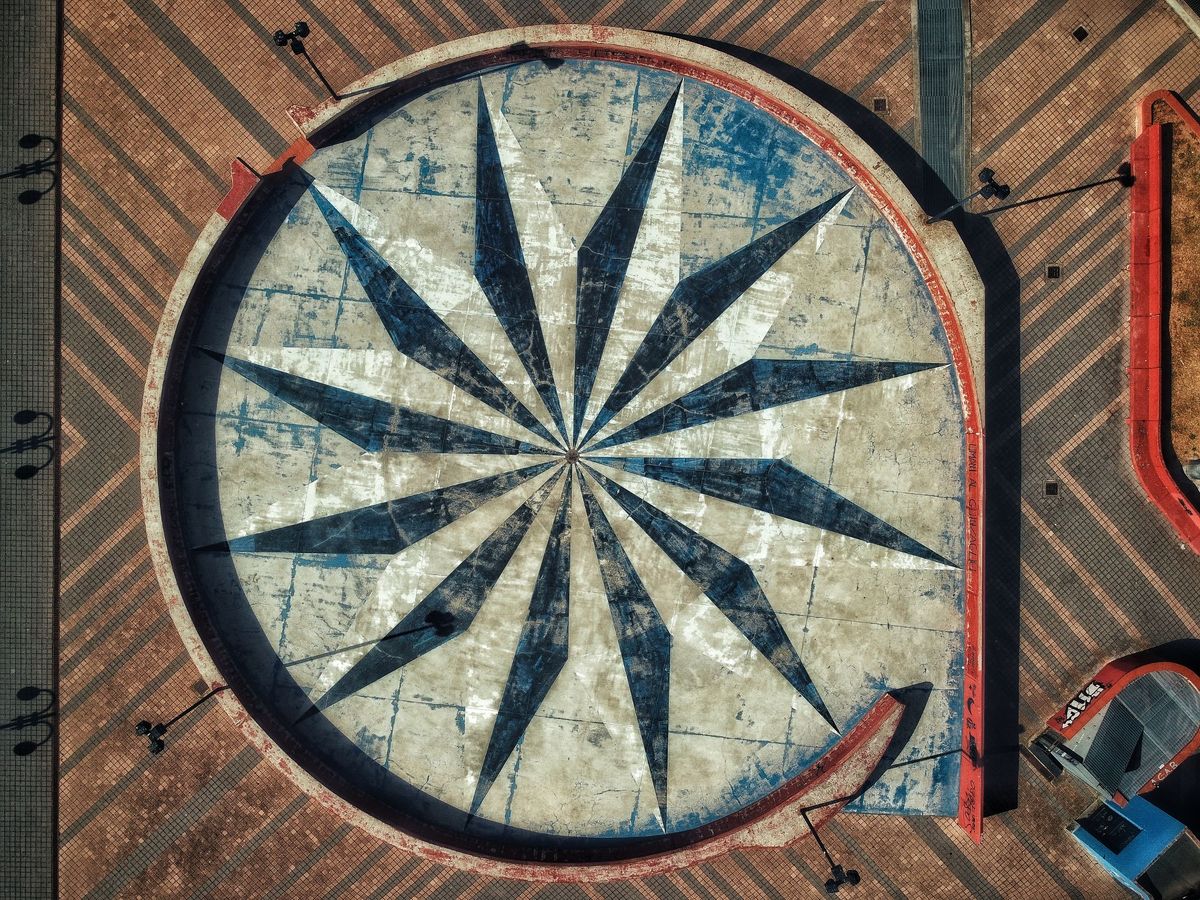
Bisect once more and the rose reaches its traditional fullness: 32 points, 11.25 degrees apart. The 16 new points, the quarter-winds, are named by the system's most distinctive rule. A quarter-wind is spoken as the nearest principal point, then "by," then the direction of its lean: the point one step east of north is north by east (NbE, 11.25 degrees); one step west of north is north by west (NbW, 348.75). Northeast by north (NEbN, 33.75) leans from northeast toward north; northeast by east (NEbE, 56.25) leans from northeast toward east. The "by" construction is a compression algorithm in spoken form: it generates 16 names from the 16 already learned, with no new vocabulary to memorize, and it is unambiguous over a shouted order or a crackling radio in a way that "eleven point two five degrees" never will be. Master the pattern, cardinal or ordinal, by the neighboring cardinal it leans toward, and the entire quarter-wind set unfolds from the eight points you learned first.
The Full 32 Points, With Degrees
Here is the complete rose in order, clockwise from north. Each point is 11.25 degrees from its neighbors; multiply a point's index by 11.25 to check its bearing.
| # | Point | Abbreviation | Degrees |
|---|---|---|---|
| 0 | North | N | 0 |
| 1 | North by east | NbE | 11.25 |
| 2 | North-northeast | NNE | 22.5 |
| 3 | Northeast by north | NEbN | 33.75 |
| 4 | Northeast | NE | 45 |
| 5 | Northeast by east | NEbE | 56.25 |
| 6 | East-northeast | ENE | 67.5 |
| 7 | East by north | EbN | 78.75 |
| 8 | East | E | 90 |
| 9 | East by south | EbS | 101.25 |
| 10 | East-southeast | ESE | 112.5 |
| 11 | Southeast by east | SEbE | 123.75 |
| 12 | Southeast | SE | 135 |
| 13 | Southeast by south | SEbS | 146.25 |
| 14 | South-southeast | SSE | 157.5 |
| 15 | South by east | SbE | 168.75 |
| 16 | South | S | 180 |
| 17 | South by west | SbW | 191.25 |
| 18 | South-southwest | SSW | 202.5 |
| 19 | Southwest by south | SWbS | 213.75 |
| 20 | Southwest | SW | 225 |
| 21 | Southwest by west | SWbW | 236.25 |
| 22 | West-southwest | WSW | 247.5 |
| 23 | West by south | WbS | 258.75 |
| 24 | West | W | 270 |
| 25 | West by north | WbN | 281.25 |
| 26 | West-northwest | WNW | 292.5 |
| 27 | Northwest by west | NWbW | 303.75 |
| 28 | Northwest | NW | 315 |
| 29 | Northwest by north | NWbN | 326.25 |
| 30 | North-northwest | NNW | 337.5 |
| 31 | North by west | NbW | 348.75 |
Boxing the Compass: The Sailor's Examination
For centuries, a young sailor's rite of passage was boxing the compass: reciting all 32 points in order, clockwise and back again, without hesitation. It sounds like rote cruelty and is actually systems training. The recitation installs the rose as a circle in the mind rather than a list, so that any point's neighbors, its opposite (add 16 points, or 180 degrees), and its relation to the wind are available instantly, mid-storm, with cold hands. The tradition is worth borrowing as a learning method even now. Learn the eight principal points until they are reflex. Add the half-winds by their parentage rule. Add the quarter-winds by the "by" rule. Then practice the recitation in both directions and the opposites: south is north's opposite, east-northeast answers west-southwest, north by east answers south by west. Within a week of short daily practice the rose stops being a table you consult and becomes a dial you think with, which is the difference between knowing the names and knowing the compass.
The Older Names: Winds Before Points
Underneath the geometric system lies an older one, and the Mediterranean still speaks it. The classical wind names named the directions by the winds that blew from them and the places they came from: Tramontana from the north, across the mountains; Greco from the northeast, toward Greece; Levante from the east, where the sun rises; Scirocco from the southeast, the hot wind off the Sahara; Ostro from the south; Libeccio from the southwest; Ponente from the west, where the sun sets; and Maestro from the northwest. The eight-wind rose of the Tower of the Winds in Athens and of medieval portolan charts is this system drawn. Its survival in Italian and Spanish weather speech is a reminder that direction names were once weather forecasts: to name the wind was to predict the day. The 32-point system that replaced it traded that poetry for precision, and a complete compass education holds both: the points for steering, the wind names for reading the old charts and the old books on their own terms.
Using the Points Today: Bearings, Weather, and Words
Modern navigation runs on degrees, and GPS speaks nothing else, so why keep the points? Three living uses answer. Weather and wind reports still speak in named directions, and a forecast "northwesterly" or a sailing report's "south-southwest, freshening" is a point name doing its old job; knowing the rose converts them to degrees without a lookup. Verbal directions between people, on trails, on water, on a radio, remain clearer in points than in numbers, because a point name carries its own error-checking: "west by north" misheard is still near west, while "two eight one" misheard as "two eight five" is a silent four-degree lie. And the points remain the native language of the literature and history of exploration; the logbooks, novels, and charts of the sailing centuries are written in them. Our guide on orienting a map and compass puts the compass to work in the hand; this article is its dictionary, and a navigator deserves both.
Related Guides
Readers working through this topic usually need its closest companions too. These travel and outdoors map skills guides cover the neighboring ground:
- Compass Directions: The 4, 8, 16, and 32 Points of the Compass Rose, With Degrees: Compass directions are a naming system laid over a circle.
- How to Read a Compass on Google Maps: The Hidden Compass, North-Up, and the Blue Beam: The compass on Google Maps hides until you need it: it appears only when the map has been rotated away from north-up, as a small red-and-white...
- How to Use a Compass Bezel on a Watch: The Seiko Method, Both Hemispheres: A compass bezel turns an ordinary analog watch into a sun compass, if you know the setting ritual: point the hour hand at the sun, put the south...
Frequently Asked Questions
How many points are on a compass rose?
The traditional full rose has 32 points: 4 cardinal points (north, east, south, west), 4 ordinal points (northeast, southeast, southwest, northwest), 8 half-winds (such as north-northeast), and 16 quarter-winds (such as north by east). Each point is 11.25 degrees from its neighbors.
What does "north by east" mean?
It is a quarter-wind: one point, 11.25 degrees, east of north, at a bearing of 11.25 degrees. The "by" names the direction of the lean from the principal point. North by west is the mirror image, 11.25 degrees west of north, at 348.75 degrees.
How are the half-wind names formed?
By joining the two points the half-wind sits between, starting from the nearer cardinal or ordinal structure: between north and northeast is north-northeast, between east and southeast is east-southeast. The name reads as a direction leaning toward the second element.
What is boxing the compass?
Reciting all 32 points in order, traditionally clockwise and counterclockwise, as a sailor's proficiency test. It builds the rose as a mental circle, so neighbors and opposites of any point are instant. Practicing it remains the fastest way to actually learn the system rather than merely look it up.
Are compass points still used, or only degrees?
Degrees dominate instruments and GPS, but points survive in weather and marine language, in verbal directions where a name is harder to mishear than a number, and throughout historical charts and literature. The two systems convert exactly: multiply a point's index, counting from north clockwise, by 11.25 degrees.
Photo credits: Jaiju Jacob (Pexels); Massimo Lavagna (Pexels). Photos are served from this site; follow the credit to the library page for the original.