A plus code is a short code, made of letters, numbers, and one plus sign, that names a small area anywhere on Earth. You have probably already seen one without noticing: drop a pin in Google Maps and the information panel shows a string like MXQ4+M6 New York. That string is a plus code, and you can search it, share it, and navigate to it like an address, even for places that have no address at all.
To try one right away, use the Plus Code Finder on this page: click the map to get the code for any spot and see the exact cell it names, or look up a full code to see where it lands.
Interactive map
Plus Code Finder
Click any spot on Earth and get its plus code: the short address that works where street addresses do not. Type a full code below to see where it lands.
Plus code for the marked spot, 11 digits
87G7MXQ4+M67
The outlined cell is what this code names: about 2.8 m north to south and 2.6 m east to west at this latitude.
Street addresses feel universal until you leave the streets that have them. A large share of the world lives or works where roads are unnamed, houses are unnumbered, or addresses exist on paper but not in any database a driver can search. Think of an informal settlement on the edge of a fast growing city, a farmhouse at the end of an unmarked track, a market stall that moves, a beach, a trailhead, or a tent camp set up after a flood or an earthquake.
In those places, everyday tasks get hard in the same specific way. A delivery driver circles and phones for directions. An ambulance crew loses minutes asking which path, which gate, which house. A resident cannot give an address for a bank account, a voter registration, or a utility connection, because no address exists to give. Latitude and longitude solve the precision problem, since every point has them, but a pair like 40.689167, -74.044444 is long, easy to mistype, and hard to say on the phone or paint on a sign.
A plus code is the compromise: coordinates compressed into a short, speakable code that works offline, costs nothing, and needs no street network at all. Relief teams have used codes to address temporary camps, delivery firms use them for rural drops, and hikers use them for meeting points far from any road name. If you are still building confidence with the underlying numbers, start with how to find coordinates and come back here once the pairs feel familiar.
Where You Have Already Seen One
Open Google Maps, drop a pin on any spot, and open the pin panel. Alongside the coordinates you will find the plus code for that spot, usually shown in its short compound form with a locality name. Tap it and it copies. Search a full code in Google Maps or Google Search and the map jumps straight to the cell.
That visibility is why plus codes spread. They are not a separate app or a paid service. They ride inside the map most people already use, so a code you send works on the phone already in your friend's pocket. Businesses print compound codes on listings, and aid organizations print them on signs where no street address can be printed instead.
How the Grid Works, in Plain Language
Plus codes are built on an open standard called Open Location Code, published by Google in 2014. The code is free to use, the method is public, and anyone can compute codes with no permission, no account, and no registry. In practice the system is not owned by anyone: Google maintains a reference library, but the codes themselves are just mathematics applied to latitude and longitude.
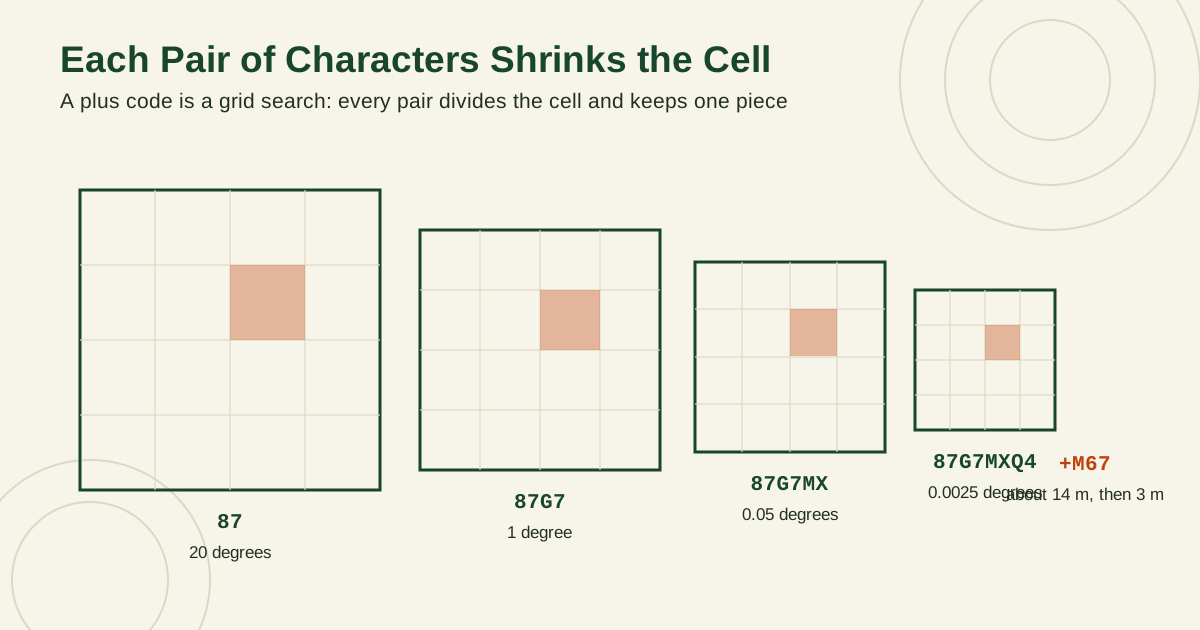
Imagine the world covered by a grid. The first characters of a code pick one huge cell of that grid. Each following pair of characters divides the current cell into a finer grid and picks one smaller cell inside it. Pair by pair, the cell shrinks from the size of a region down to the size of a building plot. The plus sign sits after the eighth character as a fixed landmark, which makes codes easy to recognize at a glance and hard to confuse with a postal code.
Four nested grid cells showing a plus code narrowing from a 20 degree area to a single small cell as each pair of characters is added
The code alphabet deliberately avoids characters that are easily confused or that form common short words, which is why you will see plenty of letters like C, F, G, H, J, M, P, Q, R, V, W, and X, and digits from 2 to 9, but never a 0 or a 1. If a code you received seems to contain a zero, it is almost certainly the letter O misread, or the code is not a plus code at all.
Because a code is computed from coordinates, the relationship runs both ways. Any app can turn latitude and longitude into a code, and any app can turn a full code back into the cell it names, with no lookup in a central database. That is why codes work offline: the math travels with the device. The formats behind the coordinates themselves are explained in latitude and longitude format.
The Precision Ladder: Longer Code, Smaller Cell
Each pair of characters shrinks the cell dramatically. This ladder is the heart of the system, so it is worth reading slowly.
Code length
Span of one cell
Approximate size on the ground
2 digits
20 degrees
A large region of a continent
4 digits
1 degree
About 111 km across
6 digits
0.05 degrees
About 5.5 km across
8 digits
0.0025 degrees
About 275 m across
10 digits
0.000125 degrees
About 14 m across
11 digits
Refines the 10 digit cell
About 3 m by 3.5 m
A note on counting: in this ladder, digits means characters of the code, not counting the plus sign. A standard full code has 10 characters plus the plus sign, such as 87G7MXQ4+M67 without its final refinement, and the 11 character version adds one more character to slice the 14 m cell into a grid of much smaller boxes, reaching roughly 3 m by 3.5 m.
For everyday use, 10 characters is the sweet spot. A cell about 14 m across is roughly the size of a house plot or half a basketball court, small enough for a driver to find the right gate. The 11th character helps when several doors or stalls share one plot. Shorter codes are not useless: an 8 character code naming a 275 m cell is plenty for a campsite area or a village center, as long as everyone understands it names an area, not a point.
Reading a Code Backwards: One Decode, Step by Step
Encoding runs from coordinates to code. Decoding runs the film backwards, and watching one full decode makes the ladder concrete. Take the Statue of Liberty code from this article, 87G7MXQ4+M67, and open it pair by pair.
The first pair, 87, selects one cell 20 degrees wide, a slab of the world containing the whole northeastern United States and a good part of the Atlantic. The second pair, G7, divides that slab into a grid and keeps one cell of 1 degree, about 111 km across, holding New York City and its harbor. The third pair, MX, keeps a cell of 0.05 degrees, about 5.5 km across, covering the harbor islands. The fourth pair, Q4, on the far side of the plus sign, keeps a cell of 0.0025 degrees, about 275 m of latitude: Liberty Island itself, with water around it. The final pair and the refinement character, M67, slice that island cell down to the full code's cell.
The finished cell is small enough to pace out. Decoding the full code with the reference tested implementation behind the finder on this page gives a cell spanning latitude 40.689150 to 40.689175 and longitude -74.044469 to -74.044437. That is 0.000025 degrees of latitude, about 2.8 m, and 0.00003125 degrees of longitude, about 2.7 m at New York's latitude. The center of the cell, 40.689162, -74.044453, is the point a map pin shows when you search the code. Drop the refinement and decode the 10 character code 87G7MXQ4+M6 instead, and the same arithmetic returns the larger cell of about 14 m by about 11 m that contains it.
Two habits follow from the decode. First, a code never names a point, only the cell whose edges the decode prints, so quote a code the way you would quote a small field, not a doorstep. Second, decoding needs no network and no permission, because there is nothing to look up: any device holding the public method can repeat the arithmetic above and land on the same four edges.
Full Codes and Compound Codes
A full code works anywhere on Earth with no other information. The Statue of Liberty has the full code 87G7MXQ4+M6 at 10 characters, and 87G7MXQ4+M67 with the 11th character added. Paste either into a map search and you land on Liberty Island, no city name required.
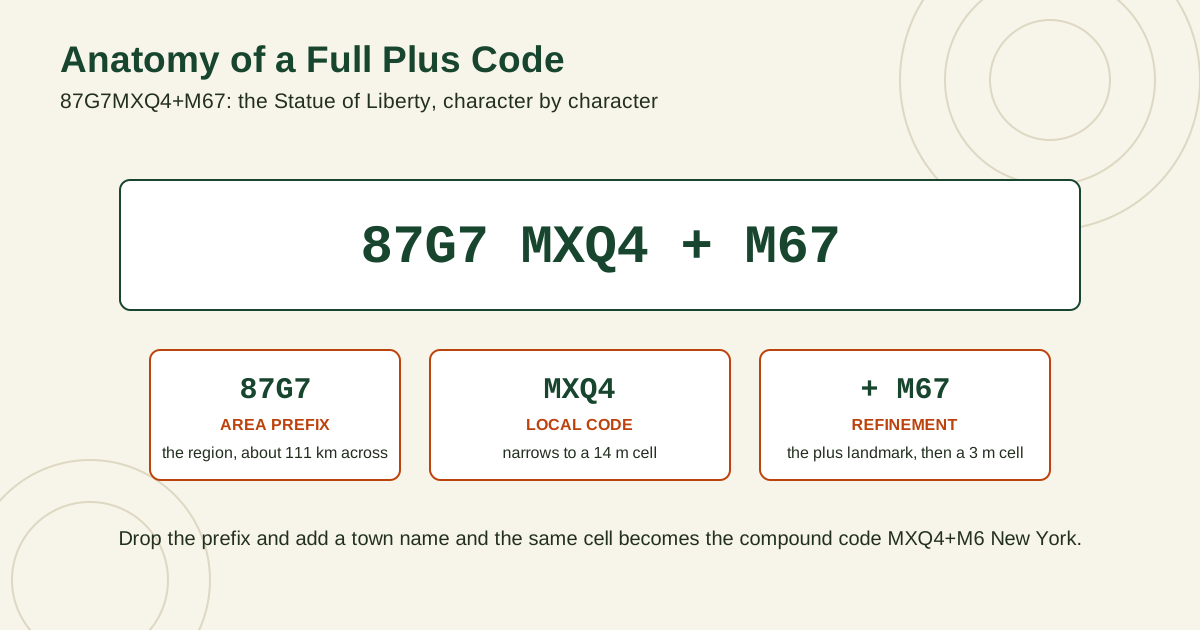
The full plus code 87G7MXQ4+M67 broken into its three parts: the area prefix 87G7, the local code MXQ4, and the refinement after the plus sign
A compound code, also called a short code, drops the first four characters and adds a locality name instead: MXQ4+M6 New York. The first four characters are the area prefix, and the locality name replaces them, because anyone who knows the city can reconstruct the rough area. Compound codes are shorter to say, write, and print, which is why Google Maps displays them by default.
The trade is scope. A compound code only works near its named locality. MXQ4+M6 New York is meaningless in Chicago, where the same short string, completed with a different prefix, names a different cell. Use compound codes for local sharing, signs, and delivery notes inside one town. Use full codes for anything that travels: international messages, documents, datasets, and anywhere the reader might not know which city you mean. When in doubt, send the full code. It is only four characters longer and it can never be misunderstood.
How to Use a Plus Code
Finding a place from a code takes seconds. Copy the code, paste it into the Google Maps search box or Google Search, and the map shows the cell with a pin at its center. In the Plus Code Finder above, looking up a full code draws the actual cell boundary, which is more honest than a pin: you see the whole area the code names, not just its middle.
Sharing your own spot is just as direct. Drop a pin on the exact gate, door, or meeting point, open the panel, and copy the plus code. Send the full code if the other person is coming from outside the area. Add a human note when the cell is big or the approach matters, such as the code plus the words gate on the north side. A code gets a driver to the cell; one short sentence gets them to the right door inside it.
On a delivery note, a plus code earns its keep where addresses are weak. Write it after the address line, or in place of one, in its full form. Couriers and aid distributors who work with codes can search it directly. For events, camps, and rural rentals, hosts increasingly print the code on booking confirmations for the same reason: it survives bad handwriting, translation, and missing street signs. If you also share raw coordinates, how to find coordinates shows how to copy them from the same pin.
Plus Codes of Places You Know
Abstract ladders are easier to believe with famous ground under them. The table below gives nine places most readers can picture, each with its full code at 10 characters and its compound code for local use. Every code was computed for this guide from the place's coordinates in OpenStreetMap data, read on November 19, 2026, using the same reference tested implementation that powers the finder on this page. None of them was looked up in a registry, because there is no registry to look in: anyone can recompute any row and get the same string.
Place
Full code (10 characters)
Compound code
Statue of Liberty
87G7MXQ4+M6
MXQ4+M6 New York
Big Ben, London
9C3XGV2G+75
GV2G+75 London
Eiffel Tower, Paris
8FW4V75V+7R
V75V+7R Paris
Sydney Opera House
4RRH46V8+74
46V8+74 Sydney
Golden Gate Bridge
849VRG9C+8J
RG9C+8J San Francisco
Colosseum, Rome
8FHJVFRR+9Q
VFRR+9Q Rome
Taj Mahal, Agra
7JVW52GR+2R
52GR+2R Agra
Christ the Redeemer, Rio de Janeiro
589R2QXQ+6R
2QXQ+6R Rio de Janeiro
Tokyo Skytree
8Q7XPR66+27
PR66+27 Tokyo
Read the full codes slowly and the geography shows through. Places on the same continent share their opening characters, because the first pairs name the region before they name the cell, and the codes sort the world the way the grid does. Test any row yourself: paste the full code into a map search, or into the finder above, and watch the cell land on the building you expect.
Turn a Code Back Into Coordinates
Codes travel well, but some devices and forms still want the raw pair. The converter below accepts a full plus code and returns the latitude and longitude of its cell center, along with the same point in degrees minutes seconds and degrees decimal minutes, so a code received on paper can enter any system that expects numbers.
Interactive tool
Coordinate Converter: Turn a Code Back Into Coordinates
Paste a full plus code and read the latitude and longitude of its cell, plus the same point in DMS and DDM, so a code can travel into any device.
From decimal degrees
Degrees minutes seconds40° 41' 21.00" N, 74° 02' 40.00" W
Degrees decimal minutes40° 41.350' N, 74° 02.667' W
Plus code (11 digits)87G7MXQ4+M67
Plus code (10 digits)87G7MXQ4+M6
Your latitude breaks down as 40 degrees, 41 minutes, 21.00 seconds. One degree is 60 minutes, one minute is 60 seconds, so a second of latitude is about 31 meters on the ground.
From degrees minutes seconds
Decimal degrees40.689167, -74.044444
Degrees decimal minutes40° 41.350' N, 74° 02.667' W
Plus code (11 digits)87G7MXQ4+M67
Conversions use the WGS 84 coordinate system, the same one GPS satellites and phone maps use. Plus codes are computed with the open location code algorithm, the same method Google Maps uses.
Accuracy and Limits, Stated Honestly
A plus code names an area, not a door, and not a point. Even the longest common code names a cell a few meters across. That is a strength for addressing, since a building genuinely occupies an area, but it means a code alone cannot say which entrance, which floor, or which unit. Pair the code with one line of human direction for the final meters.
A code also says nothing about routes. Two cells side by side may be separated by a river, a fence, or a cliff, and the code cannot know that. Navigation still depends on roads and paths in the map, which is why downloading maps ahead matters in remote areas, as covered in how to download offline maps.
There is no registry and no verification. Anyone can compute the code for any cell, which keeps the system free and open, but it also means a code on a sign or a listing is only as trustworthy as whoever put it there. Check an unfamiliar code on the map before you travel, the same way you would check any pin. Finally, a code inherits the accuracy of the position it was made from. A code generated from a phone fix that was off by 30 m faithfully names the wrong 14 m cell, so generate codes from a settled, zoomed in pin rather than a jumping blue dot.
Plus Codes, what3words, and Raw Coordinates Compared
System
Form
Open or proprietary
Precision
Needs internet or an account
Plus codes
Letters and numbers with a plus sign
Open standard, free for anyone to compute
About 14 m at 10 characters, about 3 m by 3.5 m at 11
No, works offline once you have a map or the math
what3words
Three ordinary words
Proprietary, controlled by one company
About 3 m squares
Generally needs the company system or app
Raw coordinates
Two decimal numbers
Open, universal
As precise as the digits you carry
No, any GPS or map can use them
The fair summary is this. Raw coordinates are the universal foundation: every system, including both code systems, is built on them, and they will work in any tool forever. Plus codes trade a little of that universality for brevity and offline, no owner convenience, and they are searchable in the most widely used map in the world. what3words trades openness for words some people find easier to remember, at the cost of depending on one company's system and word lists. For sharing with the public, plus codes are usually the practical middle: short, free, and open. For technical work, keep the coordinates too. Sending both costs nothing and covers every reader.
Related Guides
Readers working through this topic usually need its closest companions too. These coordinates guides cover the neighboring ground:
Is a plus code the same as a zip code or postal code?
No. A postal code names a delivery district drawn by a postal service, often covering many streets. A plus code is computed from latitude and longitude and names one small cell, about 14 m across at full length, anywhere on Earth, including oceans, forests, and places with no postal service at all.
Can I get a plus code for my house?
Yes. Drop a pin on your house in Google Maps, or click your house in the Plus Code Finder above, and read the code shown. Use the full code for anything official or long distance, and the compound code, with your town name, for local sharing.
Do plus codes work without the internet?
The codes themselves do. Converting between coordinates and codes is pure math, so apps can do it offline, and a code printed on paper works with any map. You still need a map, downloaded or paper, to travel to the cell. See how to download offline maps for the practical setup.
Why does my plus code end differently from my neighbor code?
Because the final characters refine the cell. Neighbors share the early characters, which name the shared region and neighborhood, and differ in the last characters, which pick out each separate small cell. Codes that look similar name places that are close together.
Can a plus code be wrong or fake?
A code always names a real cell, because it is just math, but it can name the wrong cell if it was copied badly or generated from a poor location fix. Always preview an unfamiliar code on a map before relying on it, and check that the cell sits where the sender described.