Convert Latitude and Longitude to Degrees Minutes Seconds (DMS)
By the Osm4People editorial team
Photo: Katerina Holmes / Pexels
Degrees, minutes, and seconds is the oldest way of writing a position, the format of paper charts, land records, and a good many forms that still refuse to accept a decimal point. Converting into it is simple arithmetic with exactly one trap, and this article is built around defusing that trap. You will convert two real places by hand, the Eiffel Tower and Big Ben, so that both the northern and western hemispheres get covered, learn the carry rule that keeps your seconds honest, pick up spreadsheet formulas for batch jobs, and finish with a round-trip check that proves every conversion before you rely on it.
The converter on this page will do all of this instantly, and for a single pair you should let it. The by-hand method below exists for the moments a tool is not at hand, and for the more important skill: recognizing when a converted value is wrong.
Interactive tool
Coordinate Converter: Decimal to DMS, With the Carry Done for You
Paste a decimal pair and read its degrees, minutes, and seconds, carried correctly at every 60. Check one of the article's worked pairs, the Eiffel Tower or Big Ben, and watch the tool agree with your hand arithmetic.
From decimal degrees
Degrees minutes seconds40° 41' 21.00" N, 74° 02' 40.00" W
Degrees decimal minutes40° 41.350' N, 74° 02.667' W
Plus code (11 digits)87G7MXQ4+M67
Plus code (10 digits)87G7MXQ4+M6
Your latitude breaks down as 40 degrees, 41 minutes, 21.00 seconds. One degree is 60 minutes, one minute is 60 seconds, so a second of latitude is about 31 meters on the ground.
From degrees minutes seconds
Decimal degrees40.689167, -74.044444
Degrees decimal minutes40° 41.350' N, 74° 02.667' W
Plus code (11 digits)87G7MXQ4+M67
Conversions use the WGS 84 coordinate system, the same one GPS satellites and phone maps use. Plus codes are computed with the open location code algorithm, the same method Google Maps uses.
The Method in Three Steps
Take the decimal coordinate and set its sign aside; work with the positive number, and let the hemisphere letter carry the direction at the end.
Degrees are the whole number part. Nothing to compute.
Minutes: multiply the leftover fraction by 60. The whole number part of the result is the minutes.
Seconds: multiply the new leftover fraction by 60. That result, usually rounded to two decimals, is the seconds.
Then attach the letter: N or S for latitude, E or W for longitude, from the sign you set aside (positive latitude is N, negative is S; positive longitude is E, negative is W).
Worked Example One: The Eiffel Tower
The Eiffel Tower stands at 48.858222, 2.2945 in decimal degrees.
Latitude 48.858222. Degrees: 48. Fraction 0.858222 × 60 = 51.49332, so minutes: 51. Fraction 0.49332 × 60 = 29.60, so seconds: 29.60. Positive latitude, so the letter is N. Result: 48° 51' 29.60" N.
Longitude 2.2945. Degrees: 2. Fraction 0.2945 × 60 = 17.67, so minutes: 17. Fraction 0.67 × 60 = 40.20, so seconds: 40.20. Positive longitude, letter E. Result: 2° 17' 40.20" E.
The pair in DMS: 48° 51' 29.60" N, 2° 17' 40.20" E. Notice how small the longitude degrees are; Paris sits barely east of the prime meridian, which runs through London, and the number tells you so at a glance.
Worked Example Two: Big Ben, and the Western Hemisphere
Longitude -0.124625. Set the minus aside and work with 0.124625. Degrees: 0. Fraction 0.124625 × 60 = 7.4775, minutes: 7. Fraction 0.4775 × 60 = 28.65, seconds: 28.65. The minus returns as the letter W. Result: 0° 07' 28.65" W.
Zero degrees is a legitimate answer, not an error: Big Ben stands less than a tenth of a degree west of the prime meridian, in the meridian's own city. Leading zeros in minutes and seconds (07, 02.62) are conventional padding, keeping columns tidy; they change nothing.
The Carry Rule: When Seconds Round Up to 60
Here is the trap, and it catches everyone once. Suppose your seconds compute to 59.997 and you round to two decimals: 60.00. Sixty seconds is not a valid field; seconds live between 0 and 60, exclusive at the top. The fix is a carry, exactly like carrying in addition: 60.00 seconds becomes 0 seconds and one extra minute. And if that pushes minutes to 60, carry again into the degrees.
A clean example: a latitude of 10.999999 decimal. Degrees 10, fraction 0.999999 × 60 = 59.99994, minutes 59, fraction 0.99994 × 60 = 59.9964, seconds 60.00 after rounding. Carry: seconds become 0, minutes become 60, carry again: degrees become 11, minutes 0. Final: 11° 00' 00.00", which is exactly right, since 10.999999 is a hair below 11. Any converter or form that shows you 59' 60" has skipped the carry, and any form that rejects your 60" is correct to do so; fix the value, not the form. The converter on this page carries automatically, which is one more reason to prefer it for values you will publish or submit.
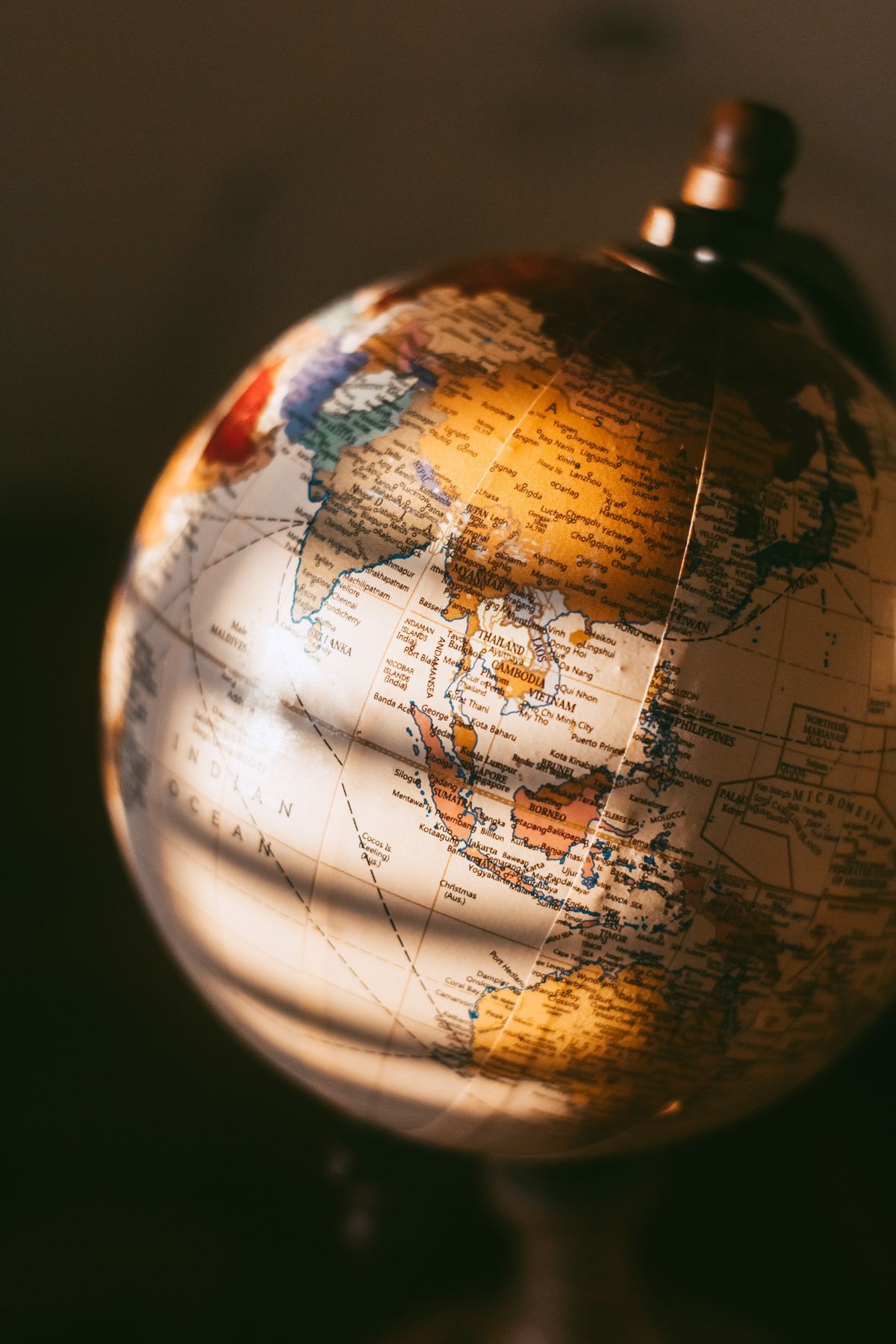
A close-up of a vintage globe lit by warm light
Spreadsheet Formulas: Excel and Google Sheets
For a column of decimals, the same three steps become formulas. With a decimal latitude in cell A2:
Hemisphere (latitude): =IF(A2>=0,"N","S") and for a longitude column, "E" and "W" in place of "N" and "S".
One warning that matters more than the formulas: the seconds formula can produce 60 in the last row of a bad day, the carry rule again, and spreadsheets will not carry for you. Sort or scan the seconds column for any 60 before you ship the results, and fix those rows by hand. To go the other way, from DMS columns back to decimal, the formula is =(degrees + minutes/60 + seconds/3600) with the sign applied by hemisphere, which our companion article convert latitude and longitude to decimal degrees works through in full.
The Round-Trip Check
Prove every conversion by converting back. Decimal equals degrees plus minutes over 60 plus seconds over 3,600. For the Eiffel Tower's latitude: 48 + 51/60 + 29.60/3600 = 48 + 0.85 + 0.008222 = 48.858222, our starting number to the last digit. For Big Ben's longitude: 0 + 7/60 + 28.65/3600 = 0.124625, with the W restoring the minus. If your round trip lands within a whisker of the start (a difference in the sixth decimal is rounding, not error), the conversion is proven. If it lands somewhere else, the error is in the forward conversion, the back conversion, or a dropped sign, and thirty seconds of checking has saved you from navigating to, mailing to, or publishing a wrong point. This is the same three-point discipline our hub article convert latitude and longitude teaches, with the plot-it step replaced here by arithmetic because DMS values so often live on paper.
The Error Gallery: Five Ways This Goes Wrong
Knowing the method is half the skill; knowing its failure shapes is the other half. The decimal-minute impostor: someone hands you 48° 51.493' (DDM) and you read it as 51 minutes 493 seconds, or convert it as if 51.493 were minutes and seconds glued together. The giveaway is a seconds value over 60, or a decimal point inside the minutes. The dropped sign: -0.124625 converted cheerfully to 0° 07' 28.65" E, teleporting Big Ben from west of Greenwich to east of it. The letter is not decoration; it is the sign, wearing formal clothes. The false precision copy: seconds rounded at every intermediate step instead of only at the end, drifting the answer by a second or two; carry full precision through the multiplications and round once, last. The swapped pair: latitude and longitude converted beautifully, each in the wrong slot; the plot check in our hub article catches it, because the point lands in an ocean. The 60 that stayed: a seconds field of 60.00 submitted proudly, the carry rule skipped; any competent form rejects it, and now you know the fix is arithmetic, not argument. Keep this gallery in mind and you will spot most bad DMS values at reading speed, before any conversion begins.
Related Guides
The closest companions to this guide are the coordinates guides below. Each one picks up a thread this page starts:
Because the system is Babylonian, inherited through Greek astronomy: the degree was divided into 60 minutes, each into 60 seconds, in a base-60 tradition older than the decimal point. The words themselves confess it: minute means the first small part, second means the second small part, in Latin. We keep the system because charts, records, and instruments are saturated with it.
How many decimal places should seconds have?
Two is the working standard. One second of latitude is about 30.9 m on the ground, so a hundredth of a second is about 31 cm, finer than any phone GPS reading. More decimals pretend to an accuracy the original measurement never had; fewer throw away real precision from good instruments.
What do I do when a form wants DMS but my value has no seconds?
Pad with zero seconds: 48° 51' 00". A position given only to the minute is honest but coarse, one minute of latitude being about 1.85 km, so the padded form describes a neighborhood, not a doorstep. If the exact point matters, get a decimal reading from a phone first, then convert.
Can longitude minutes or seconds also carry into degrees?
Yes, identically. The carry rule is about the fields, not the coordinate: any seconds field that rounds to 60 carries one minute; any minutes field that reaches 60 carries one degree. Longitude degrees can climb to 180 at the antimeridian, where the carry produces 180° 00' 00", the one place a three-digit degree is normal.
Why does my GPS show degrees and decimal minutes instead?
Because DDM, degrees with decimal minutes, is the marine and aviation convention, and many handheld units default to it. It is not DMS and the two must never be mixed: 51.407 minutes is not 51 minutes 40.7 seconds. Change the unit's position format setting to DMS if that is the dialect you need, or convert with the tool on this page; our hub convert latitude and longitude shows all the formats side by side.
Is DMS or decimal degrees more accurate?
Neither. They are exact re-expressions of the same number, and a conversion loses nothing except what rounding trims. Accuracy lives in the original measurement: a phone fix good to 5 m stays good to 5 m in any format, and a position paced off a paper map stays approximate in all of them.
How do I write DMS correctly in a document or form?
The conventional order is degrees, then the degree symbol, minutes with a prime mark, seconds with a double prime, then the hemisphere letter, like 48° 51' 29.60" N. If the form provides separate boxes for each field, fill them as plain numbers and put the letter in its own box if it has one, or select it from the dropdown it offers. When typing into plain text where the symbols are awkward, the accepted fallback is words: 48 degrees 51 minutes 29.60 seconds N. What you must never do is glue the parts into a decimal lookalike like 48.512960, which reads as decimal degrees and moves the point by kilometers while looking tidy.
Photo credits: Katerina Holmes (Pexels); Maria Stewart (Pexels). Photos are served from this site; follow the credit to the library page for the original.