Every parabola has exactly one turning point, the vertex, and half of school algebra seems designed to make finding it feel harder than it is. It is two computations. The x-coordinate comes from one small formula, and the y-coordinate comes from putting that x back into the function. Everything else in this guide, the alternative forms, the shortcuts, the error traps, exists to make those two computations reliable and to give you ways to check them. Work the examples with a pencil. By the end, the vertex of any quadratic they hand you should take under a minute, with a check to spare.
Home / Coordinates and Location Formats
How to Find the Coordinates of the Vertex of a Parabola: Three Methods

Photo: Allen Boguslavsky / Pexels
Interactive tool
Find the Vertex: The Method Checklist
Check off each step as you finish it. Your progress stays on this page.
0 of 6 complete
0% done
What the Vertex Is, and Why It Has Coordinates Worth Finding
A parabola is the graph of a quadratic function, f(x) = ax^2 + bx + c. If a is positive, the graph opens upward like a bowl and the vertex is its bottom, the minimum. If a is negative, the graph opens downward like a hill and the vertex is its top, the maximum. The vertex is written as an ordered pair, (h, k): h is where the turn happens along the x-axis, k is the extreme value the function reaches there. This is why the point matters beyond graphing homework. The vertex of a projectile's height function is the peak of the throw. The vertex of a profit function is the price or quantity where profit maxes out. The vertex of a cost curve is the cheapest operating point. In each case the question "where does it turn, and how high" is exactly the ordered pair this guide computes. The axis of symmetry, the vertical line x = h that folds the parabola onto itself, passes through the vertex, and it is the key to the fastest method of all, coming below.
Method One: The Formula, h = -b / 2a, Then k = f(h)
Start with the function in standard form and read off the three coefficients, with their signs welded on. For f(x) = 2x^2 - 8x + 5: a = 2, b = -8, c = 5. The x-coordinate of the vertex is h = -b / (2a). Substitute with the signs: -(-8) / (2 times 2) = 8 / 4 = 2. So the turn happens at x = 2. Now the step students skip and must not: the y-coordinate is not another formula, it is the function evaluated at that x. k = f(2) = 2(2)^2 - 8(2) + 5 = 8 - 16 + 5 = -3. The vertex is (2, -3). Since a = 2 is positive, the parabola opens upward and (2, -3) is its minimum, which a rough sketch confirms: at x = 0 the function is 5, it falls to -3 at x = 2, and by symmetry it is back to 5 at x = 4. Notice the shape of the whole method: one formula for h, one evaluation for k. Two computations, no memorized k formula, nothing to misremember under exam pressure.
A Second Example, With a Negative a
Run f(x) = -x^2 + 6x - 5. Coefficients: a = -1, b = 6, c = -5. Then h = -b / (2a) = -6 / (2 times -1) = -6 / -2 = 3. Evaluate: k = f(3) = -(3)^2 + 6(3) - 5 = -9 + 18 - 5 = 4. Vertex: (3, 4). Because a is negative, the parabola opens downward and (3, 4) is the maximum, the top of the hill. Sanity check by symmetry: the function at x = 1 is -1 + 6 - 5 = 0, and at x = 5 it is -25 + 30 - 5 = 0, and the midpoint of 1 and 5 is 3, which is h. That symmetry check is not a coincidence; it is Method Three arriving early, and it catches arithmetic slips for free whenever the roots are easy to see.
Method Two: Vertex Form, by Completing the Square
Any quadratic can be rewritten as f(x) = a(x - h)^2 + k, called vertex form because the vertex, (h, k), is sitting visibly in the equation. Getting there is completing the square. Take f(x) = 2x^2 - 8x + 5 from Method One. Factor a out of the x terms: 2(x^2 - 4x) + 5. Inside, take half of -4, which is -2, square it to get 4, and add and subtract it: 2(x^2 - 4x + 4 - 4) + 5. The first three terms are a perfect square: 2((x - 2)^2 - 4) + 5 = 2(x - 2)^2 - 8 + 5 = 2(x - 2)^2 - 3. Read the vertex straight off: (2, -3), matching Method One exactly. Two warnings live here. The sign trap: the form is (x - h), so an equation showing (x + 3)^2 has h = -3, not 3; the most common vertex error in all of algebra is reading that sign backwards. And when a is not 1, it must be factored out before completing the square inside, or the square you complete is the wrong one. Vertex form earns its keep when the problem asks about shifts and transformations, or hands you the equation already in this form; converting a standard-form problem solely to find the vertex is honest work but slower than Method One.
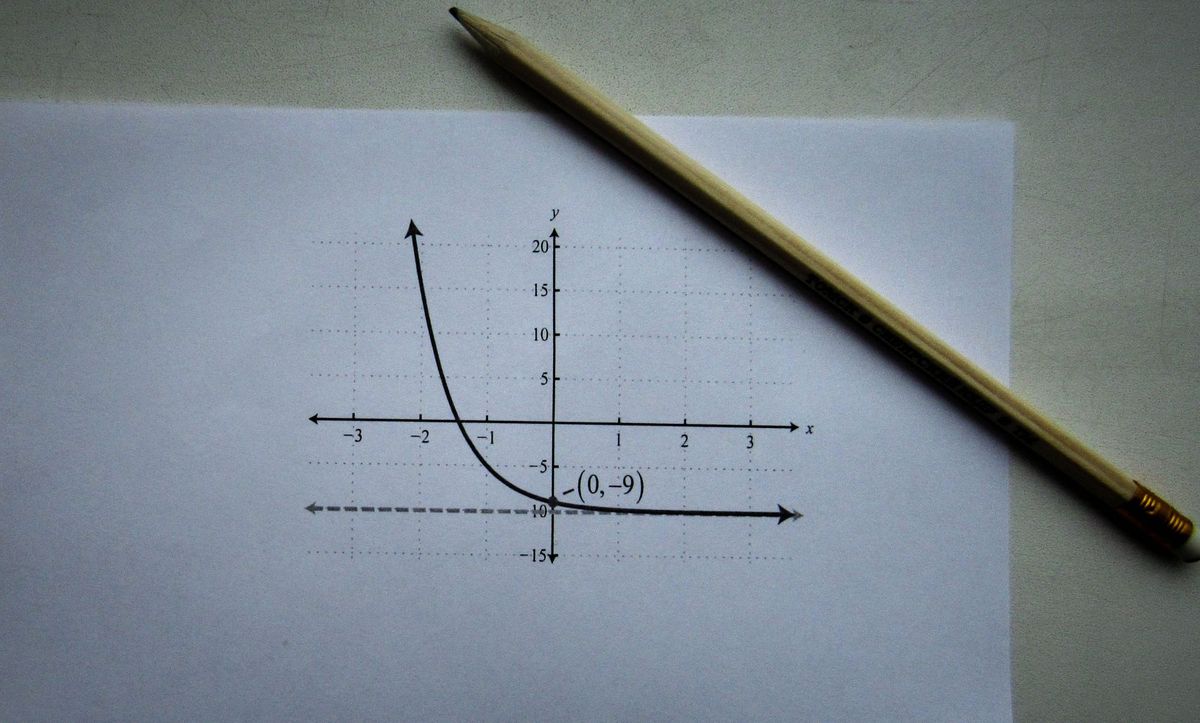
Method Three: The Midpoint of the Roots
The parabola's symmetry gives a third route. If the function has two roots, the x-intercepts where it crosses zero, the vertex's x-coordinate is exactly halfway between them, because the axis of symmetry folds one root onto the other. Factor or solve to find the roots, average them, and that average is h; evaluate f(h) for k as always. The second example above demonstrated it: roots at 1 and 5, midpoint 3. This method shines when the quadratic factors kindly, which in textbooks is often, and it doubles as the universal check on Method One even when you only spot one root region from a graph. Its limits are equally clear: if the roots are irrational or do not exist, when the parabola floats entirely above or below the axis, factoring may be unavailable and the formula method carries the load alone. Professionals keep all three methods because each verifies the others; a vertex found two ways is a vertex you can submit without a prayer.
The Error Clinic: Where Vertex Answers Die
Nearly every wrong vertex is one of four deaths. First, the sign of b: in h = -b / 2a, the leading minus belongs to the formula. With b = -8, the numerator is -(-8) = 8; students who write -8 have answered the mirror-image problem. Second, forgetting k entirely and submitting (h, f-something-else), or reporting just h as "the vertex"; the vertex is a point, and a point has two coordinates. Third, the vertex-form sign flip from Method Two: (x + 3)^2 means h = -3. Fourth, arithmetic in the evaluation: f(2) means substitute 2 everywhere, including squaring before multiplying, order of operations intact; the classic casualty is computing 2(2)^2 as (2 times 2)^2 = 16 instead of 2 times 4 = 8. The defenses are procedural. Write a, b, c down with signs before touching the formula. Evaluate k in a separate, unhurried line. Then run any cheap check available: symmetry against a second point, the midpoint if roots show, or the direction test, an upward parabola's vertex must sit below its neighbors, so if your k is higher than f(0) and f(4) on an upward opener, something is wrong and it is findable.
Maximum or Minimum: Reading the Answer Like It Matters
Finish every vertex problem by interpreting the pair, because the interpretation is usually the actual question. The sign of a decides the kind: positive a, the vertex is a minimum; negative a, a maximum. In applied dress: a ball's height modeled by h(t) = -16t^2 + 64t + 5 has a = -16, b = 64, so the peak arrives at t = -64 / (2 times -16) = 2 seconds, at height h(2) = -64 + 128 + 5 = 69 feet. Vertex (2, 69): two seconds up, sixty-nine feet high, and both numbers answer real questions a coach or engineer asked. A revenue function R(x) = -10x^2 + 600x turns at x = -600 / -20 = 30, the quantity or price step that maximizes revenue, with k the maximum revenue itself. Train the reflex: h is the where or the when, k is the how much, and the pair together is the answer. Students who stop at the formula own a technique; students who read the pair own the subject, and it is the reading that the coordinates pillar of this site exists to teach, here applied to the hardest-working point in algebra.
Related Guides
If this page answered part of the question, these coordinates guides cover the rest of the same ground:
- How to Find the Centre Coordinates of a Circle: Four Methods, Worked in Full: The centre of a circle hides in plain sight in every form of its equation, and each representation gives a different way to read it off.
- Latitude and Longitude History: From Eratosthenes to the Greenwich Vote: Latitude was measurable in the ancient world; longitude resisted for two thousand years.
- Latitude and Longitude Questions and Answers: The Standard Questions, Explained Plainly: Why does latitude stop at 90 but longitude runs to 180? How long is one degree? Why does the Earth turn 15 degrees an hour, and why do you need...
Frequently Asked Questions
What is the formula for the vertex of a parabola?
For f(x) = ax^2 + bx + c, the x-coordinate is h = -b / (2a). The y-coordinate is k = f(h), found by substituting h back into the function. The vertex is the ordered pair (h, k). There is no separate k formula worth memorizing; evaluating the function is the method.
How do I find the vertex if the equation is in vertex form?
Read it directly. In f(x) = a(x - h)^2 + k, the vertex is (h, k). Beware the sign: the form subtracts h, so f(x) = 2(x + 3)^2 + 1 has vertex (-3, 1), not (3, 1). The value of a still tells you whether that point is a maximum or a minimum.
Is the vertex a maximum or a minimum?
The sign of a decides. If a is positive, the parabola opens upward and the vertex is the minimum, the lowest point. If a is negative, the parabola opens downward and the vertex is the maximum, the highest point. State which one yours is whenever you report the coordinates.
Can I find the vertex from the x-intercepts?
Yes, when the parabola has two roots. The axis of symmetry passes halfway between them, so h is the average of the two roots; then k = f(h) as usual. It is the fastest method when the quadratic factors easily, and a reliable check on the formula method even when you use the formula first.
What if the parabola has no x-intercepts?
The vertex still exists and the formula method still works unchanged: compute h = -b / (2a) and evaluate f(h). Only the midpoint-of-roots method is unavailable, since there are no roots to average. A parabola with no intercepts simply turns entirely above or below the x-axis.
Photo credits: Allen Boguslavsky (Pexels); Sergey Meshkov (Pexels). Photos are served from this site; follow the credit to the library page for the original.