The centroid is the triangle's balance point, the spot where a cardboard cutout of the triangle would balance on a pin, and its coordinates obey the most democratic formula in geometry: average the vertices. Every vertex gets one vote. Add the three x coordinates and divide by three for the centroid's x; add the three y coordinates and divide by three for its y. That is the entire computation, and this guide's worked examples take under a minute each. What deserves the rest of the page is the proof habit: the centroid is defined as the intersection of the triangle's medians, and checking your average against one median, with its famous 2 to 1 division, converts a formula you remember into an answer you have verified. The guide closes with the confusion clinic, because the centroid shares the exam stage with the circumcenter and the orthocenter, and picking the wrong center is the standard way this topic loses marks. This page is the triangle case of our general how to find centroid coordinates guide, which covers polygons and other shapes; here the triangle gets the full treatment.
Home / Coordinates and Location Formats
How to Find the Centroid Coordinates of a Triangle: Average the Vertices, Then Prove It With the Medians
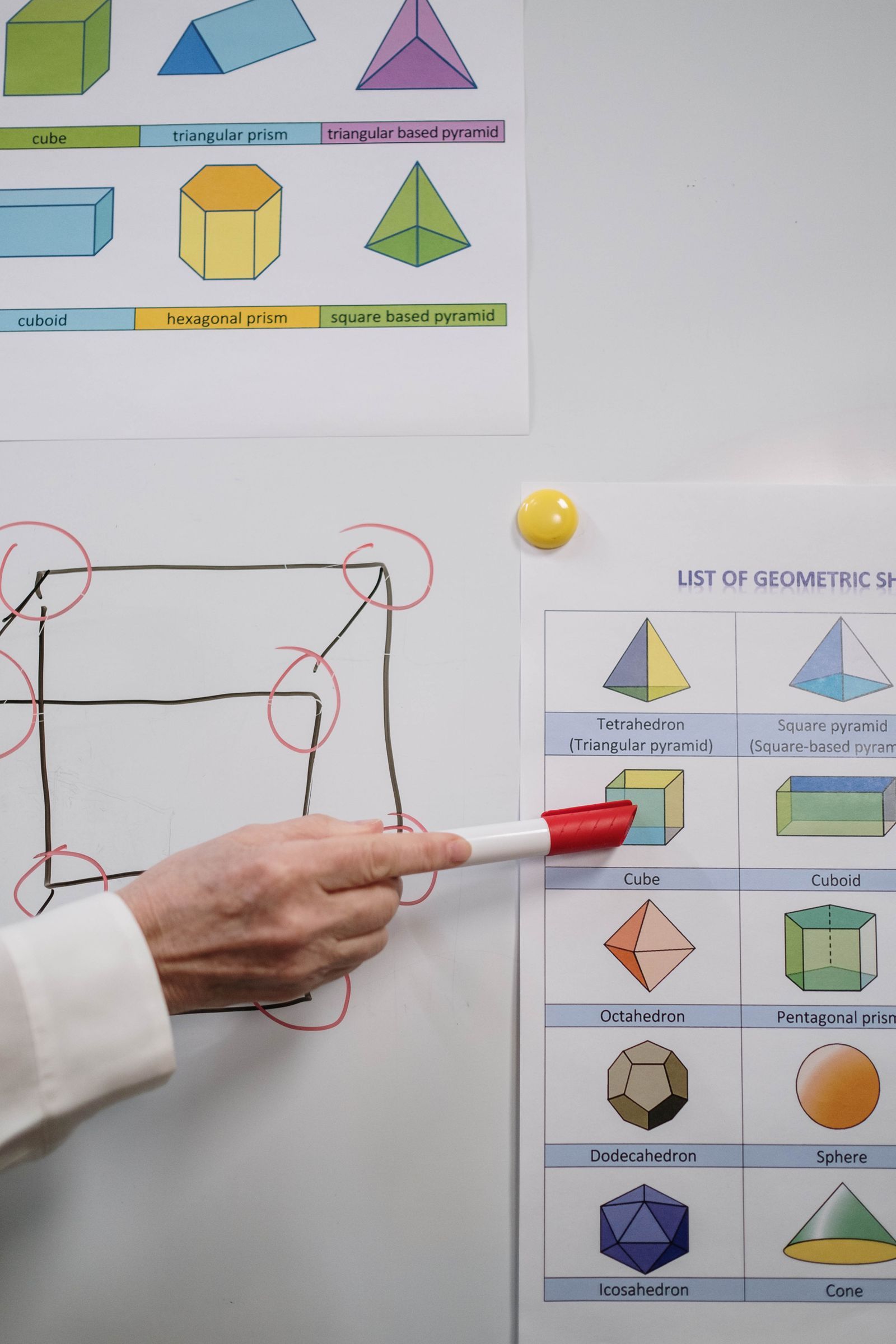
Photo: cottonbro studio / Pexels
Coordinate Explorer: Three Vertices, One Average
Click the three corners of any triangle and read each pair. Add the three x values and divide by three, then do the same for y: that average is the centroid this article derives.
Map data © OpenStreetMap contributors. Coordinates are read from the map itself, in the WGS 84 system your phone uses.
The Formula and the First Worked Example
For vertices (x1, y1), (x2, y2), and (x3, y3), the centroid G is:
G = ((x1 + x2 + x3) / 3, (y1 + y2 + y3) / 3)
Take the triangle (0, 0), (6, 0), (3, 6), a tall triangle standing on the x axis. The x average: (0 + 6 + 3) / 3 = 9 / 3 = 3. The y average: (0 + 0 + 6) / 3 = 6 / 3 = 2. The centroid is (3, 2). Sanity check before any proof: the centroid must lie inside the triangle, and (3, 2) plainly does, on the triangle's axis of symmetry, a third of the way up its height of 6. That inside test is your first line of defense; a computed centroid outside the triangle is not a subtle answer, it is an arithmetic error announcing itself. Note also what the average does with the shape: the two base vertices pull the y down, the apex pulls it up, and the result, 2, sits at the balance height the physical intuition predicts.
The Proof Habit: One Median, Divided 2 to 1
A median runs from a vertex to the midpoint of the opposite side, and the centroid is where the three medians meet. The meeting point divides each median in the ratio 2 to 1, counting from the vertex: the centroid sits two thirds of the way from any vertex toward the opposite side's midpoint. Verify the example with the median from the apex (3, 6). The opposite side is the base from (0, 0) to (6, 0), whose midpoint is (3, 0). The median is the segment from (3, 6) down to (3, 0), a vertical line of length 6. Two thirds of the way from the vertex: 6 minus (2/3 times 6) = 6 minus 4 = 2, landing at (3, 2), exactly the averaged answer. Run this check whenever the stakes justify it; it takes twenty seconds, uses independent machinery (midpoints, which our coordinates between two points guide covers), and catches the classic errors, a misadded coordinate or a division by two instead of three, before they settle. Any median works for the check; they all pass through the same point, which is the theorem the definition rests on.
A Second Example, With Nothing Lined Up
Take (2, 1), (8, 3), and (5, 10), a triangle with no symmetry to lean on. The x average: (2 + 8 + 5) / 3 = 15 / 3 = 5. The y average: (1 + 3 + 10) / 3 = 14 / 3, approximately 4.67. The centroid is (5, 4.67). Inside test: the point sits within the triangle's span and plausibly amid its area, closer to the base edge between the two low vertices than to the high apex, as the two to one pull predicts. Median spot check, from the apex (5, 10): the opposite side runs from (2, 1) to (8, 3), midpoint (5, 2). The median runs from (5, 10) to (5, 2), and two thirds down from the vertex gives y = 10 minus (2/3 times 8) = 10 minus 5.33 = 4.67, with x = 5 throughout. The average and the median agree again, as they must. When a centroid problem resists, it is almost never the formula; it is a vertex copied wrong from the diagram, which the inside test and the median check expose between them.

A Third Example: Negative Coordinates Change Nothing
Take (minus 4, minus 2), (2, minus 2), and (minus 1, 4), a triangle straddling the axes. The x average: (minus 4 + 2 + minus 1) divided by 3 = minus 3 divided by 3 = minus 1. The y average: (minus 2 + minus 2 + 4) divided by 3 = 0 divided by 3 = 0. The centroid is (minus 1, 0), sitting on the x axis inside the triangle. Median check from the apex (minus 1, 4): the opposite side runs from (minus 4, minus 2) to (2, minus 2), with midpoint (minus 1, minus 2); two thirds of the way down from the apex, y = 4 minus (2/3 times 6) = 0, and x stays minus 1. Agreement again. Negative coordinates are the case students brace for and the formula does not notice: addition handles signs, and the average lands where the balance is, on whichever side of the axes that happens to be.
The Confusion Clinic: Centroid vs Circumcenter
Three centers haunt triangle problems, and the exam's favorite trick is asking for one while your memory supplies another. The centroid is the intersection of the medians, the average of the vertices, the balance point, always inside the triangle. The circumcenter is the intersection of the perpendicular bisectors, the center of the circle passing through all three vertices, equidistant from them, and it can fall outside the triangle when the triangle is obtuse. The orthocenter is the intersection of the altitudes, a third point with its own habits. The clinic's demonstration uses our first triangle, (0, 0), (6, 0), (3, 6). Its centroid is (3, 2). Its circumcenter: the perpendicular bisector of the base is the line x = 3, and the perpendicular bisector of the side from (0, 0) to (3, 6) meets it at (3, 2.25). Two centers, a quarter unit apart on the same line: close enough that a sloppy answer key shrug is understandable, different enough that the distinction is exactly what is being tested. Decision rule: medians or balance or average means centroid; circle through the vertices or perpendicular bisectors means circumcenter. Read the question's machinery, not its mood.
Why the Average Works: The One Paragraph of Insight
The averaging formula feels like a coincidence until you see the medians inside it. The midpoint of a side is the average of two vertices. The centroid divides the median 2 to 1, so its coordinates are a weighted blend: one third of the midpoint plus two thirds of the opposite vertex. Substitute the midpoint's average into that blend and every vertex ends up weighted exactly one third: the three vertex average. The formula is the median theorem after algebra, which is why the median check in this guide can never disagree with a correctly computed average, and why disagreement always means arithmetic, not geometry. The same averaging idea scales: the centroid of a polygon and of a set of points generalizes the vertex average, with area weighting entering for polygons, the territory of the parent guide. For the triangle, equal weights are the whole story, because the triangle is the one polygon whose balance point needs nothing more.
Applications That Actually Use It
The centroid earns its keep wherever a triangle stands in for something physical or computational. In graphics and game development, triangle centroids anchor shading decisions, object placement, and mesh simplification, computed millions of times by exactly this average. In surveying and GIS, a triangular parcel's centroid serves as its label point and representative location, the same representative point idea our coordinate guides use when a polygon needs a single pair. In engineering, the centroid of a triangular plate or load diagram is where the resultant force acts, the balance point definition made literal. And in the classroom, the centroid is the friendliest of the centers because its formula needs nothing but addition and division by three, no slopes, no bisectors, no systems of equations, which is precisely why confusing it with its harder cousins is such an unforced error. Learn the average, keep the median check in your pocket, and the triangle's center is a solved problem.
Related Guides
Readers working through this topic usually need its closest companions too. These coordinates guides cover the neighboring ground:
- How to Find the Coordinates of a Midpoint: The Average, and When It Lies: The midpoint between two coordinates is usually just an average: add the latitudes and divide by two, add the longitudes and divide by two.
- How to Find Coordinates by Address: Forward Geocoding in Maps, Nominatim, and Bulk: Turning a street address into latitude and longitude is called forward geocoding, and there are three ways to do it depending on how many...
- How to Find Coordinates in Google Earth: Cursor Readout, Placemarks, and Formats: Google Earth shows the coordinates of any point in the lower right corner as your cursor moves, but most people never notice the readout, and...
Frequently Asked Questions
What is the formula for the centroid of a triangle?
G equals ((x1 + x2 + x3) / 3, (y1 + y2 + y3) / 3): average the three vertices' x coordinates for the centroid's x, and average the y coordinates for its y. For (0, 0), (6, 0), and (3, 6), the centroid is (3, 2).
How can I check my centroid answer?
Use a median. Find the midpoint of any side, then move two thirds of the way from the opposite vertex toward that midpoint; you should land on your computed centroid, because the centroid divides every median 2 to 1 from the vertex. Also confirm the point lies inside the triangle; a centroid outside it is always an error.
Is the centroid the same as the circumcenter?
No. The centroid is the intersection of the medians and the average of the vertices; the circumcenter is the intersection of the perpendicular bisectors and the center of the circle through the vertices. For the triangle (0, 0), (6, 0), (3, 6), the centroid is (3, 2) while the circumcenter is (3, 2.25).
Can the centroid of a triangle be outside the triangle?
No. The centroid always lies inside, because it sits on every median at the 2 to 1 point, and medians run through the interior. This is a reliable error check. The circumcenter and orthocenter, by contrast, can fall outside an obtuse triangle.
Why do you divide by three when finding the centroid?
Because the centroid weights all three vertices equally: it is their mean position. The median construction proves it: the centroid is two thirds of the way from a vertex to the opposite side's midpoint, and substituting that midpoint (itself an average of two vertices) makes every vertex's total weight exactly one third.
Photo credits: cottonbro studio (Pexels); Yan Krukau (Pexels). Photos are served from this site; follow the credit to the library page for the original.